 Televisor LED COB todo en uno
 Pantallas LED flexibles
 Pantallas LED transparentes
 Cartel llevado
 Pantallas LED circulares
 Pantallas LED de columna
 Pantallas LED creativas y personalizadas
Televisor LED todo en uno vs. pared LED tradicional: ¿Cuál es la mejor opción para tu espacio?
Both use LED technology. Both deliver high brightness and wide viewing angles. The difference is in integration, installation, and ongoing operation — and choosing wrong can add thousands in unnecessary project costs.
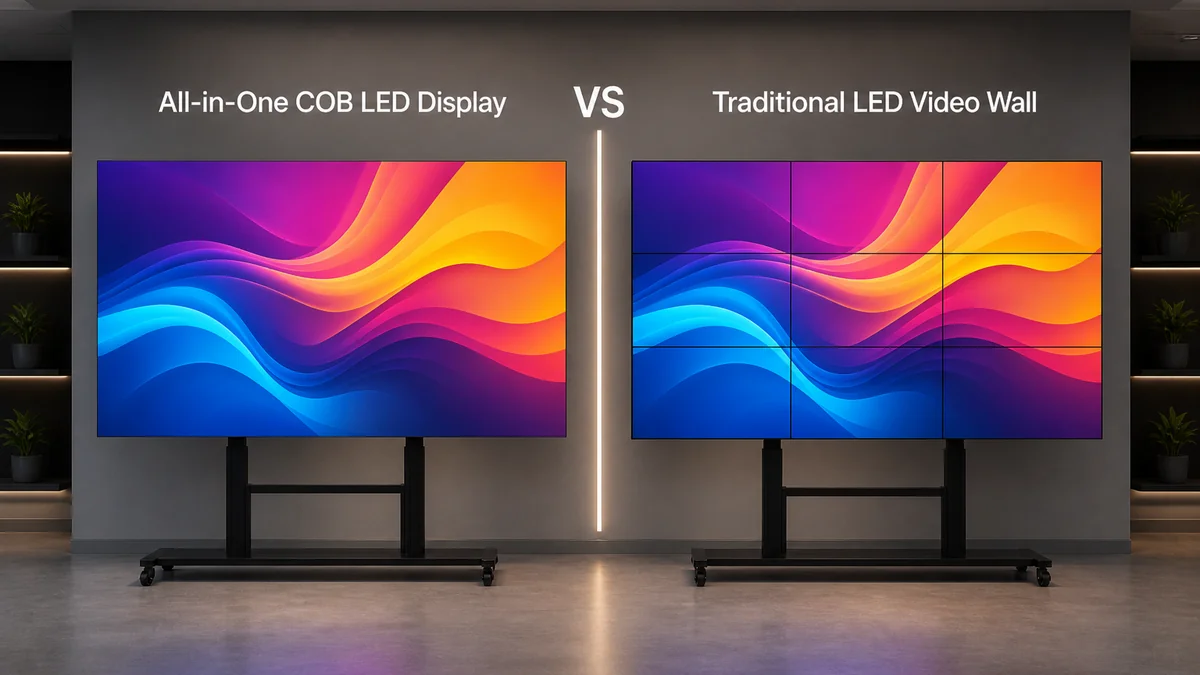
- Traditional LED wall and All-in-One LED TV use the same LED technology — COB or SMD. The difference is integration, installation, and total project cost, not image quality.
- Under 163 inches: All-in-One LED TV saves $3,000–$7,000 in total project cost by eliminating external processors, structural mounting, and professional AV installation. Above 163 inches: traditional LED wall is the only option.
- Installation time separates these products decisively. Traditional LED wall: 2–5 days with a professional crew. All-in-One LED TV: 30 minutes on a mobile stand, 2–3 hours wall-mounted — labor cost savings alone can justify the choice for corporate AV projects.
- If future expansion matters, go traditional — modular cabinets let you add panels later. If “just works like a TV” matters, go All-in-One — one power cable, no configuration, designed for local IT staff to manage.
Same LED Technology, Radically Different Products
Both All-in-One LED TVs and traditional LED walls use the same underlying technology — COB or SMD LEDs delivering high brightness, wide viewing angles, and long operational lifespans. At the component level, the light-emitting elements are identical.
The difference is in de contacto. A traditional LED wall is a construction project: modular cabinets, external video wall processors, structural mounting frames, signal distribution, power cable routing, and a professional AV installation crew to bring it all together. An All-in-One LED TV is a single self-contained unit: screen, processor, Android system, built-in speakers, and mounting hardware — one box, one power cable, plug and play.
Think of it as the difference between building a home theater from separate components versus buying a high-end television. Both deliver a great picture. One requires you — or someone you hire — to know how everything connects and calibrates. The other works the moment you plug it in.
Installation: Days vs Hours
Installation is where these two products diverge most dramatically — in time, labor, and cost.
Traditional LED Wall Installation: 2–5 Days
A professional LED wall installation is a sequenced multi-trade operation. The process typically runs:
- Instalación de la estructura — mounting brackets, steel framework, load verification (Day 1)
- Cabinet-by-cabinet mounting — each cabinet lifted, aligned, and locked (Day 1–2)
- Precise module alignment — adjusting each LED module for seamless surface flatness (Day 2)
- Receiving card configuration — each card mapped to its physical position (Day 2–3)
- Video wall processor setup — input mapping, EDID management, color calibration (Day 3)
- Signal and power cable routing — organized trunking, redundancy checks (Day 3–4)
- Final calibration and testing — brightness uniformity, dead pixel scan, 24h burn-in (Day 4–5)
This requires 2–4 people, typically a mix of structural contractors, electricians, and AV technicians. Labor alone typically runs $1,000–$5,000 depending on complexity and region.
All-in-One LED TV Installation: 30 Minutes to 3 Hours
Mobile stand configuration: One person, 30 minutes. Unbox the unit, attach the stand base, roll into position, plug in one power cable. Content plays immediately — the built-in Android system handles all processing and signal routing internally.
Wall-mount configuration: A local AV team or facilities crew, 2–3 hours. Mount the bracket, hang the unit, plug in one power cable. No configuration, no signal mapping, no calibration required — the unit is factory-calibrated and self-contained.
Para un comparable 135 pantalla pulgadas in a corporate boardroom or meeting room: traditional LED wall installation costs $2,000–$5,000 in labor, requires coordinating 3–4 trades, and takes 3–5 business days during which the room is unavailable. All-in-One wall-mount installation costs $300–$800 in labor, requires one facilities crew, and the room is back in use the same afternoon. The installation cost difference alone can be the deciding factor for corporate AV budgets.
Flexibilidad vs. Simplicidad
This is the fundamental trade-off. Neither product is universally “better” — each excels in the scenarios it was designed for.
Traditional LED Wall: Unlimited Possibilities
With modular cabinets, a traditional LED wall can become virtually any size, shape, or aspect ratio. Curved walls, irregular shapes, custom aspect ratios, mixed pixel pitch zones — the modular approach imposes no design limitations. This makes it the correct choice for architectural integration, creative installations, museum exhibits, stage design, and any space where standard rectangles don’t satisfy the brief.
A lobby with a curved video wall wrapping a column, a retail space with a floor-to-ceiling irregular display, a broadcast studio with a custom-shaped background wall — these applications require the modular freedom that only traditional LED wall construction provides.
All-in-One LED TV: Fixed Sizes, Perfect Simplicity
The All-in-One comes in fixed sizes: 108, 135, and 163 inches in standard 16:9 aspect ratio. These dimensions cover the vast majority of meeting rooms, boardrooms, lecture halls, and corporate presentation spaces — environments where a known format works perfectly and the value lies in simplicity, not customization.
If your space fits a standard 16:9 rectangle and your screen size falls within the 108–163 inch range, the All-in-One will be faster to deploy, simpler to operate, and cheaper to own than a traditional LED wall of equivalent size.
When Size Matters — Go Traditional
For displays larger than 163 inches, traditional LED wall is the única opción. The All-in-One product category stops at 163 inches because beyond that size, a single integrated unit becomes logistically impractical to ship, handle, and install.

Consider these real-world use cases where size dictates the choice:
- A 200-inch 4K display for a university auditorium — requires modular LED cabinets assembled into a single video wall.
- A curved video wall wrapping a lobby — each cabinet follows the architectural curve; no fixed-size unit can do this.
- A floor-to-ceiling column display — custom aspect ratio, no standard 16:9 product fits the vertical space.
- A panoramic multi-wall command center — spans 20+ feet across multiple connected surfaces.
If your project demands a display surface larger than 163 inches or a non-standard shape, traditional LED wall is your only path. The modular approach was built for this.
Send us your room dimensions, viewing distance, and content type. An engineer — not a sales rep — will recommend the right solution within 24 hours.
When “Just Works” Matters — Go All-in-One
The All-in-One LED TV eliminates the integration engineering that traditional LED walls demand. For many organizations, this is not a nice-to-have — it’s the difference between a project that happens and one that gets stuck in procurement.
With an All-in-One, you never need to specify or purchase separately:
- Sending cards and receiving cards — built into the unit
- Video wall processor — integrated Android system handles all processing
- Power distribution units — one standard power cable for the entire display
- Signal distribution and EDID management — zero configuration required
- Structural mounting engineering — standard VESA mount, same as a consumer TV
This matters most to corporate IT managers and facility directors. They want “a big screen that works like a TV” — content from a laptop via HDMI or wirelessly, no AV technician on speed dial, no proprietary control system to learn. The All-in-One delivers this experience in a way a traditional LED wall cannot without significant integration effort and ongoing operational complexity.
For meeting rooms where non-technical staff need to present daily, for boardrooms where reliability is non-negotiable, for lecture halls where every minute of downtime is a disrupted class — the “it just works” factor of an All-in-One creates real operational value that a traditional build cannot match at any price point.
Servicio y mantenimiento
Both technologies use modular LED panels, and both permit individual module replacement when a panel fails. The difference lies in who can do the replacement and how long it takes.
Traditional LED Wall Module Replacement
Replacing a single module on a traditional LED wall typically requires a skilled AV technician. Once the new module is installed, adjacent cabinets must often be realigned to restore seamless surface flatness — even a 0.5mm misalignment creates visible lines on fine-pitch displays. This is a 1–3 hour task that involves ladder access, precise adjustment tools, and calibration verification.
All-in-One LED TV Module Replacement
The All-in-One is designed for local IT staff to handle. The process: identify the failed module via the diagnostic overlay, release the magnetic or mechanical latch, swap in the replacement module, close the latch. No realignment needed — the module self-aligns into the frame. Typical time: bajo minuto 15. Remote video support is provided if the IT team wants guidance on their first replacement.
For a corporate campus with 10 meeting rooms equipped with All-in-One displays, the maintenance difference compounds. A traditional LED wall in each room means scheduling AV technicians for every issue — often with multi-day lead times. An All-in-One means the facilities team handles module swaps in-house, same day, zero scheduling overhead. Over a 5-year deployment, this operational independence is worth more than the hardware price difference.
Matriz de decisión: ¿Cuál debería elegir?
The table below cuts through the complexity. For each decision factor, one product is the clear winner. Use this as your selection framework.
| Factor de decisión | Ganador | Por qué |
|---|---|---|
| Need <163″ in standard 16:9 | Todo-en-Uno | Lower total cost, faster deployment, no integration engineering |
| ¿Necesita un tamaño o forma personalizados? | Pared LED tradicional | Modular cabinets handle any dimension, curve, or aspect ratio |
| Need to install in 1 day | Todo-en-Uno | 30 min mobile stand, 2–3 hr wall-mount vs 2–5 days |
| Need architectural integration | Pared LED tradicional | Designed for custom environments, mixed shapes, creative layouts |
| Want lowest total project cost | Todo-en-Uno | Eliminates external processors, mounting frames, and professional AV labor (under 163″) |
| Want unlimited future expansion | Pared LED tradicional | Add cabinets to grow the display; All-in-One is a fixed-size unit |
| Value simplicity over flexibility | Todo-en-Uno | One power cable, no configuration, designed for non-technical staff |
En pocas palabras: Most corporate meeting rooms, boardrooms, and presentation spaces under 163 inches are better served by an All-in-One LED TV — it’s faster, cheaper, and simpler. Spaces requiring custom dimensions, creative shapes, or displays larger than 163 inches need a traditional LED wall — the modular approach is purpose-built for these applications. The question isn’t which technology is better. It’s which one fits your space, your timeline, and your operational reality.
Tell us your room dimensions, content type, and installation timeline. We’ll send you a tailored recommendation with factory-direct pricing — within 24 hours, from an engineer, not a sales rep.
Is an All-in-One LED TV the same as a traditional LED wall?
Which is cheaper — All-in-One LED TV or traditional LED wall?
Can I expand an All-in-One LED TV later like a traditional LED wall?
How long does installation take for each option?
Which has better image quality — All-in-One or traditional LED wall?
Can I use an All-in-One LED TV for rental or touring events?
What happens if a panel fails on each system?
Analice sus requisitos de brillo.
Cuéntenos qué funciones necesita la pantalla. Podemos sugerirle una configuración cuadrada y confirmar los detalles de brillo y potencia para su presupuesto.
Solicitar cotización