 Televisor LED COB todo en uno
 Pantallas LED flexibles
 Pantallas LED transparentes
 Cartel llevado
 Pantallas LED circulares
 Pantallas LED de columna
 Pantallas LED creativas y personalizadas
TRANSPARENT LED DISPLAY BUYING GUIDE: FILM VS HOLOGRAPHIC VS GRID (2026)
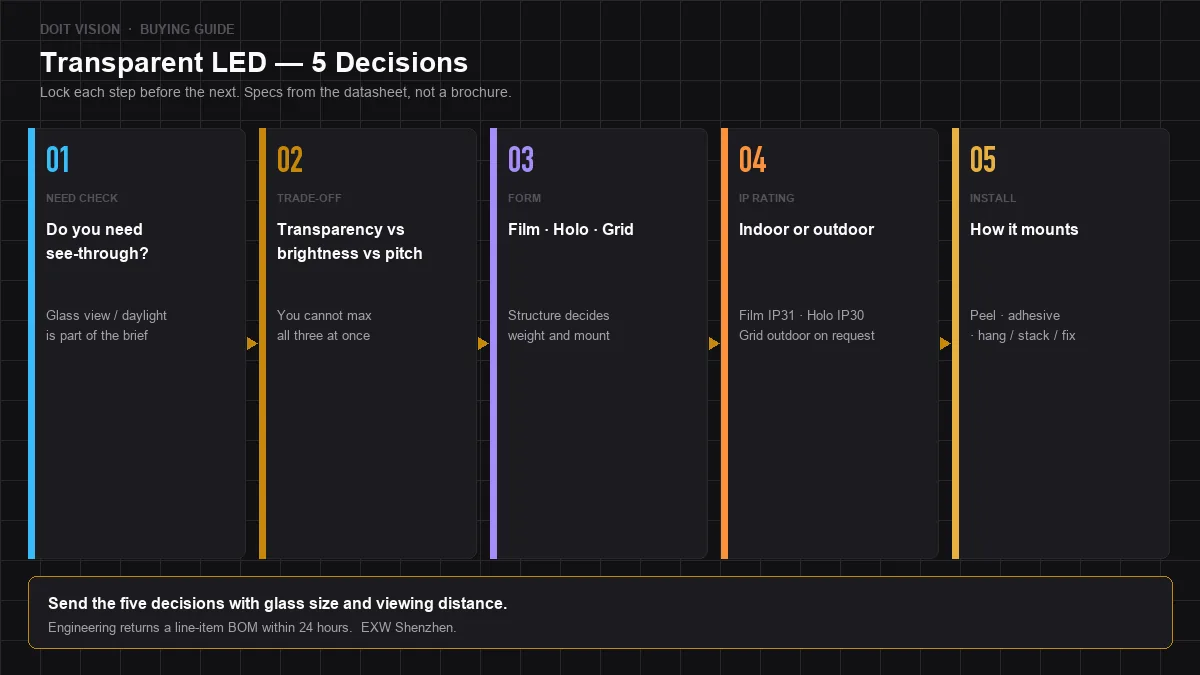
A transparent LED display puts digital content on glass while keeping the view and daylight behind it readable. Buying one means five decisions in order: whether you need transparent at all, how to balance transparency against brightness and resolution, which of three forms fits (self-adhesive Film, holographic strip, or modular Grid), indoor vs outdoor IP rating, and how it mounts. This guide walks each decision with datasheet figures — Film at 90–95% transparency, Holographic at 70–90%, and Grid at up to 5000 nits. New to transparent LED? Start with our Página de la categoría LED transparente for the three-series lineup — then return here to build your quote request.
- Three forms, three jobs: Película LED = self-adhesive 2.5mm sheet on existing glass (90–95% transparency); LED holográfico = aluminum strip frame for a floating 3D look (70–90%); Cuadrícula transparente = modular cabinet for large façades (up to 5000 nits).
- Transparent LED costs roughly 1.5–3× a comparable solid LED wall per square metre. Buy it for the see-through — never as a cheaper screen.
- The core trade-off is a triangle: transparency ↔ brightness ↔ resolution. You cannot have 95% transparency, 5000 nits, and fine pitch in one product.
- Indoor vs outdoor is a hard line: Film is IP31, Holographic is IP30, Grid is IP30 standard with an outdoor option on request. Two of three forms are indoor-only.
- Five decisions in order: (1) do you need transparent, (2) transparency vs brightness vs resolution, (3) form, (4) IP rating, (5) installation. Each constrains the next.
Three Forms in 30 Seconds — Film, Holographic, or Grid
“Transparent LED” is one search term for three different products. They share see-through construction but differ in frame, weight, pixel pitch, and where they mount. Getting this wrong at specification stage wastes weeks and budget.
- → Self-adhesive flexible PET sheet, 2.5mm thin, 1.3kg/panel
- → P5–P20, 90–95% transparency, 2000–4000 nits
- → Bonds to existing glass; cuttable and bendable to curved glass
- → Indoor IP31 · LED Film product page →
- → Aluminum frame + LED strips, module thinner than 2mm, 5kg/panel
- → P2.5–P6.25, 70–90% transparency, 3500 nits
- → Adhesive on glass for a floating 3D holographic effect
- → Indoor IP30 · LED Holographic product page →
- → Modular aluminum cabinet, 8.1–12.5kg/m²
- → P2.6–P10.4, 40–80% transparency, up to 5000 nits
- → Hang, stack, or fixed mount for large glass façades
- → Indoor IP30 (outdoor on request) · Transparent Grid product page →

The split is about structure and brightness, not a marketing tier. Film is the lightest, highest-transparency route onto glass you already have. holográfica is the fine-pitch strip look for lobbies and museums. Cuadrícula is the structural, high-brightness route for window walls that need their own frame. For a full side-by-side spec table, read Película vs. Holográfico vs. Cuadrícula. For when transparent is the wrong tool entirely, read Transparent LED Use Cases — and When Not to Use It.
Decision 1: Do You Need Transparent LED at All?
Transparent LED is a premium construction. It costs roughly 1.5–3× a comparable solid LED wall per square metre, and it never matches a solid wall on brightness or pixel density at the same pitch. Buy it for the see-through, or don’t buy it.
Transparent LED earns its premium when one of these is true:
- El view or daylight behind the glass is part of the design — storefront, lobby, showroom, museum.
- El landlord or building code bans a solid opaque wall, heavy steel, or drilling into the structure.
- Usted retrofitting existing glass you cannot replace or obscure.
A solid LED wall is the better tool when:
- Necesita maximum brightness in direct sun — solid walls exceed even Grid’s 5000 nits.
- Necesita fine pitch below P2.5 at high resolution — Holographic tops out at P2.5, Grid at P2.6, Film at P5.
- Necesitas el lowest cost per m² — solid walls are cheaper at every pitch band.
The decision is architectural, not just financial. If the brief is “we want the cheapest screen”, transparent is not the answer — start at the LED product hub. If the brief is “we must keep the glass and the view”, continue to Decision 2. For the retail case for transparent, see our LED display for retail Página de solución.
Decision 2: The Transparency–Brightness–Resolution Triangle
Three specifications pull against each other on any transparent screen. You cannot max all three in one product — the ranges below are the proof:
| Producto | Transparencia | Brillo | Resolución (tono) |
|---|---|---|---|
| Película LED | 90-95% | 2000–4000 nits | P5 – P20 |
| LED holográfico | 70-90% | 3500 nits (P3.91 3500–4500) | P2.5 – P6.25 |
| Cuadrícula transparente | 40-80% | hasta 5000 nits | P2.6 – P10.4 |

Higher transparency means wider gaps between pixels, which means fewer pixels (lower resolution) and less light output per area. Film tops transparency at 90–95% but sacrifices pitch (P5–P20) and brightness. Cuadrícula reaches 5000 nits but its 40–80% transparency means a visibly denser structure. holográfica sits in the middle on transparency while reaching the finest pitch (P2.5).
Pick the two specs you must have, then accept the third. A storefront that must stay bright in sun → Cuadrícula (brightness + structure, accept ~40–80% transparency). A lobby that must stay near-invisible → Film (transparency, accept P5+ pitch). A museum with close viewing → holográfica (fine pitch, accept mid transparency). Full engineering breakdown: Transparent LED: Transparency vs Brightness.
Decision 3: Film, Holographic, or Grid — The Quick-Select Table
Choose by the job the screen has to do. The table maps each common brief to a form and the key specs that decide it.
| If your project… | Elija | Especificaciones clave |
|---|---|---|
| Existing storefront glass, max see-through, no drilling | Película LED | 90–95% · 2.5mm · 1.3kg/panel · self-adhesive |
| Lobby / museum glass, floating 3D look, close viewing | LED holográfico | P2.5–P6.25 · 70–90% · 3500 nits · <2mm module |
| Large façade / window wall, daylight, needs its own structure | Cuadrícula transparente | up to 5000 nits · 40–80% · hang/stack/fixed |
| Outdoor weather exposure (rain, dust, direct sun) | Cuadrícula transparente (outdoor option) | IP-rated outdoor cabinet, on request |
Each form maps to a spec band — Película LED, LED holográfico, y Cuadrícula transparente. If your project needs a non-standard size, shape, or pitch outside these bands, see our pantalla LED personalizada solution. For the full side-by-side numbers, run the Film vs Holographic vs Grid comparison.
Decision 4: Indoor or Outdoor — IP Ratings Are a Hard Line
Transparent LED is mostly an indoor product. Two of the three forms are indoor-only, and the third is outdoor only on request.
| Medio Ambiente | Product & IP | Notas |
|---|---|---|
| Indoor storefront / lobby / showroom | Film IP31 · Holographic IP30 · Grid IP30 | The standard transparent install |
| Semi-outdoor covered / rain-exposed | Confirm exposure — usually outdoor Grid | “Covered” is not always indoor |
| Outdoor façade / weather exposure | Grid outdoor option (on request) | Film / Holographic are not weatherproof |
Do not assume a transparent screen is outdoor-ready. Film (IP31) and Holographic (IP30) protect against objects, not weather. If the install faces rain, dust, or direct sun with no protective overhang, specify the outdoor Grid option explicitly and confirm IP rating, brightness, and power enclosures at quotation — these are not field-upgradable after shipment.
Decision 5: How Does It Mount?
Installation is where the three forms diverge most — and where you will discover whether a project is even feasible on your glass.
- → Peel-and-stick on existing glass — no drilling, no frame
- → Cut to your glass dimensions; bendable to curved glass
- → ≤3.5kg/m²; installers mount ~20–30m²/day, two-person
- → Confirm glass thickness and surface before ordering
- → Adhesive bonding on flat or curved glass — no structural change
- → 5kg/panel; two people handle most panels
- → Cuttable to fit; ideal where landlords ban drilling
- → Ships with installation drawing and guide
- → Hang, stack, or fixed aluminum cabinets — its own structure
- → 8.1–12.5kg/m²; needs a load path and front service
- → Outdoor option adds rigging and wind-load scope
- → No glass substrate required

Film and Holographic need glass as a substrate — if there is no glass yet, Grid is the only route (or add glass first). Mounting weight matters: Film runs ≤3.5kg/m² while Grid runs 8.1–12.5kg/m², so check your glass and mullion load rating before commit. Step-by-step procedure: How to Install a Transparent LED Display.
What Does a Transparent LED Display Cost?
Transparent LED is quoted per project — size, pitch, brightness, and mounting change the number. The bands below are honest engineering references, EXW Shenzhen, confirmed against your specification at quotation:
| Formulario | Indicative EXW (USD / m²) | Principal impulsor de costos |
|---|---|---|
| Película LED | ~$400–$1,200 | Pitch + cut-to-size customisation |
| LED holográfico | ~$800–$1,800 | Fine pitch P2.5–P6.25 + strip assembly |
| Cuadrícula transparente | ~$500–$1,500 | HD vs High line, brightness, outdoor IP |
Add processor, mounting, and freight. As a rough guide, transparent runs 1.5–3× a comparable solid wall. Fine pitch, high brightness, and the outdoor IP option sit at the upper end of each band. Every quotation is a line-by-line BOM with stated MOQ and lead time — send your glass dimensions and viewing distance for a figure within 24 horas. See how our displays hold up in the field in our Estudios de caso sobre pantallas LED.
Lista de verificación antes de realizar su pedido
-
Need confirmed — transparent, not a solid wallIf the goal is the cheapest screen, a solid LED wall wins. Transparent earns its 1.5–3× premium only when the view behind the glass matters.
-
Form decided — Film vs Holographic vs GridExisting glass + max see-through → Film. Floating 3D look + fine pitch → holográfica. Large façade + daylight → Cuadrícula.
-
Transparency–brightness–resolution triangle lockedPick the two specs you must have, accept the third. See the transparency vs brightness Descompostura.
-
IP rating matched to environmentFilm IP31, Holographic IP30, Grid IP30 (outdoor option on request). Outdoor and rain-exposed sites need the outdoor Grid, not a “maybe” indoor panel.
-
Installation substrate and load confirmedFilm/Holographic: glass thickness, type, and surface. Grid: structure, load path, and mullion rating. No glass yet → Grid or add glass first. See the guía de instalación.
-
Brightness matched to orientationSouth-facing daylight → Grid (up to 5000 nits) or higher-brightness Holographic. Shaded glass → Film. Send a site photo to confirm.
-
Line-item BOM, EXW Shenzhen, with MOQ and lead timeNo placeholder numbers. Quote states MOQ, delivery date, warranty line, and control system, confirmed at quotation.
Send glass dimensions, viewing distance, orientation (indoor/outdoor), and which form you are leaning toward. An engineer returns a line-by-line BOM with MOQ and lead time — EXW Shenzhen — within 24 hours.
¿Qué es una pantalla LED transparente?
What are the three types of transparent LED display?
How transparent can a transparent LED display be?
¿Se pueden utilizar pantallas LED transparentes en exteriores?
How bright should a transparent LED display be for daylight?
¿Cuánto cuesta una pantalla LED transparente?
How is a transparent LED display installed?
What should I confirm before ordering a transparent LED display?
Analice sus requisitos de brillo.
Cuéntenos qué funciones necesita la pantalla. Podemos sugerirle una configuración cuadrada y confirmar los detalles de brillo y potencia para su presupuesto.
Solicitar cotización