 Televisor LED COB todo en uno
 Pantallas LED flexibles
 Pantallas LED transparentes
 Cartel llevado
 Pantallas LED circulares
 Pantallas LED de columna
 Pantallas LED creativas y personalizadas
3m Suspended
Borderless Circular LED Display
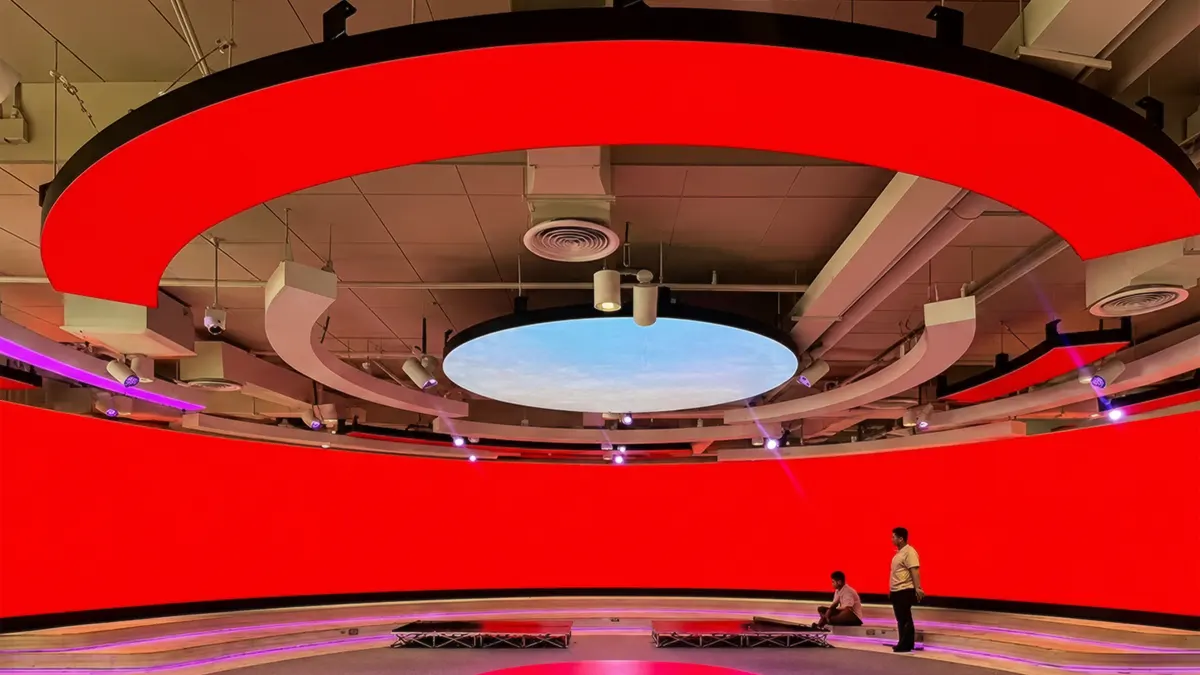
A local company's activity center in Bangkok's CBD — a compact stage area — wanted a 3-meter borderless circular LED display suspended from the ceiling, surrounded by concentric halo arcs in a "stars around the moon" composition. Because a borderless circle needs fan-shaped modules, every PCB was custom-drawn, and the pixels follow radial lines rather than a straight grid. We delivered in 45 days with upgraded N52 magnets for the inverted mount — then, after the client's pre-installed ceiling suspension points were found reversed on site, our technicians adapted the structure and performed pixel-by-pixel calibration so video still flowed seamlessly across the circle and its halos.
A simple vista
A Circle, Plus Concentric Arcs
The brief was not a simple circle. The client wanted a central 3-meter circle with several halo arcs arranged around it — a "stars orbiting a moon" composition, where the halos are physically separate structures but must read as one synchronized geometric pattern.
For the central circle, a true borderless (frameless) edge means no metal ring to hide behind. The PCB must therefore fan outward from the center in pie-slice shapes, so the curved outer edges meet edge-to-edge with zero visible seam. The halo arcs use arc-shaped boards on their own curvatures.
Unlike a rectangular wall built from standard 320×160mm modules, every PCB here was custom-drawn — fan-shaped boards for the circle, arc-shaped boards for the halos. Not a single off-the-shelf module.

Fan-Shaped Pixels vs a Straight Grid
A borderless circle looks like a floating disc of light — but that edge-free aesthetic has an engineering cost most suppliers will not tell you. Fan-shaped modules arrange pixels along radial lines, not straight rows.
In a standard framed circular display, square modules sit behind a metal ring and pixels stay on a precise x/y grid — a horizontal line in your content crosses LEDs that are all physically aligned on the same row, so it renders perfectly straight.
In a borderless display, the fan-shaped modules spread pixels outward from the center along radial lines. At the seam where two adjacent fan boards meet, the pixel rows no longer line up — a straight line crossing that seam appears slightly staggered or wavy. For content with text, logos, or architectural grid patterns, this is a real and visible compromise.
If display quality is the priority — text, logos, straight geometry — a framed circle with standard square modules delivers visibly cleaner results. A borderless circle is worth it when the "floating disc" edge is the aesthetic goal and viewers are not reading fine detail up close. We built borderless here because the client wanted the seamless look; we make the trade-off explicit before any order.
Fighting Gravity with Magnets
Standard magnetic LED modules are built for vertical walls, where gravity presses modules into the mount. Invert the display overhead, and gravity pulls them away — standard magnets fail.
DOIT VISION upgraded every module magnet to high-grade neodymium N52 — the strongest commercially available permanent magnet — with each module's holding force calculated for a 3× safety margin against gravity, vibration, and the venue sound system's acoustic pressure.
The aluminum support frame was engineered as a rigid grid with redundant anchor points every 400mm, and each suspension cable was rated for 5× the static load. The frame passed FEA simulation for zero deflection under full module weight.
Every suspended display over 1.5m in diameter carries secondary safety cables as redundant backup. If all primary suspension points failed simultaneously, the safety cables prevent any part of the display from falling.
The stronger magnets made the overhead mount safe — but they created their own problem chain. Each fan-shaped module became difficult to remove during seam adjustment: installers pried modules off with real force, repositioned them by hand, then snapped them back on. Repeated removal–realignment–reattachment cycles across dozens of modules accumulated physical damage — chipped PCB corners, cracked solder joints, dented housings. On a ceiling install, all of this alignment happens overhead, one module at a time.
A borderless module has no protective frame, so the fan-shaped PCB edges are directly exposed — even careful handling chips and cracks them. The damage here was severe enough that we dispatched an engineer from Shenzhen to Bangkok specifically to repair and replace damaged modules on-site. The cost of that international service trip — flights, accommodation, and replacement parts — exceeded the initial price difference between a borderless and a framed circle. It's a downstream cost no simple product quote will show you.


Reversed Suspension Points
During installation, the local crew discovered the client's pre-installed ceiling suspension points had been reversed — left and right anchor positions were swapped relative to the approved structural drawings. The mounting direction was wrong.
Rather than delay the project by weeks to re-drill the ceiling, DOIT VISION technicians adapted the structural mounting on-site: the aluminum frame was reconfigured to match the existing anchors, and the LED modules were remounted to the new layout.
Before any content plays correctly, a circular display must be mapped in the LED processor software as a radial topology — each fan-shaped module assigned to its physical position with non-linear signal paths, not a rectangular grid stretched into a circle. On this project, four processor ports (P1–P4) route data through the fan boards in paths that mirror the physical wiring.
Because the circle and halos now sat in slightly different positions than the planned pixel map, pixel-by-pixel software micro-calibration was required — each module's pixel offset was individually adjusted so video flowed seamlessly across the circle and its arcs despite the physical deviation.

Circular topology is drawn and addressed in the processor software — not a rectangular grid stretched into a circle. Left: standard rectilinear cabinet mapping. Right: fan-shaped circular topology with P1–P4 signal paths.

Especificaciones del proyecto
How This Project Was Delivered
Análisis de requisitos
Diameter, halo layout, ceiling load, and content type captured in a 1-page engineering brief — including the borderless-vs-framed trade-off decision.
PCB & Structure Design
Custom fan-shaped and arc-shaped PCB layouts, aluminum support frame, and N52 magnet sizing — designed for DFM from day one.
Factory Aging & Validate
Full halo arc segments powered on and signal-tested at the Shenzhen facility before crating — every arc verified for pixel continuity and color uniformity.
Production & Install
45-day production to delivery, on-site mounting, processor topology mapping, and pixel-by-pixel calibration against the reversed suspension points.

Planning a circular LED display?
Borderless or framed, suspended or wall-mounted — get our honest recommendation and a feasibility assessment within 48 hours. We'll tell you which edge treatment fits your content before you commit.
Preguntas frecuentes
Can DOIT VISION design borderless circular LED displays with halo rings?
What is the difference between a borderless and a framed circular LED display?
Why do straight lines look slightly bent on a borderless circular display?
How do you safely mount a circular LED display on the ceiling?
What happens if ceiling suspension points don't match the drawings?
How do you map video across a circle and its separate halo arcs?
How fast can you deliver a fully custom circular LED display?
Productos y recursos
Pantallas LED circulares
Framed and borderless solid discs. Compare pixel layouts, weight, and lead time by diameter.
Explorar →Pantallas LED de anillo
Hollow halo with open centre — the form used in this Bangkok suspended borderless ring and concentric halo array.
Explorar →LED creativo y con forma
Cylinders, rings, cubes, spheres — full custom geometry engineering.
Explorar →Pantallas LED flexibles
Bendable modules for curved and compound surfaces. Custom curvature radius support.
Explorar →Tu forma personalizada, diseñada con precisión.
Envíenos los planos o un boceto aproximado del diámetro y la altura; evaluaremos si una solución flexible por sí sola es viable. Le responderemos en un plazo de 24 horas.
Contacta con un ingeniero por WhatsApp Solicitar cotización Ver todos los casos prácticos