 Televisor LED COB todo en uno
 Pantallas LED flexibles
 Pantallas LED transparentes
 Cartel llevado
 Pantallas LED circulares
 Pantallas LED de columna
 Pantallas LED creativas y personalizadas
Guía de certificaciones para pantallas LED: CE, EMC, FCC, RoHS: todo lo que un comprador debe saber.
Recibes la solicitud de cotización de tu cliente. Veinte líneas de especificaciones. Y al final, una lista de certificaciones.
CE. RoHS. EMC Class B.
Se lo reenvías al fabricante de pantallas LED con el que has estado hablando. Su representante de ventas responde en cinco minutos: “Los tenemos todos.”
¿Ellos?
CE is there. But is the EMC inside it Class A or Class B? RoHS — the whole screen, or just a few components? UL — the power cord, or the entire display?
Esta guía no es un libro de texto. Trata sobre lo que realmente importa cuando eres tú quien tiene que responder al cliente.
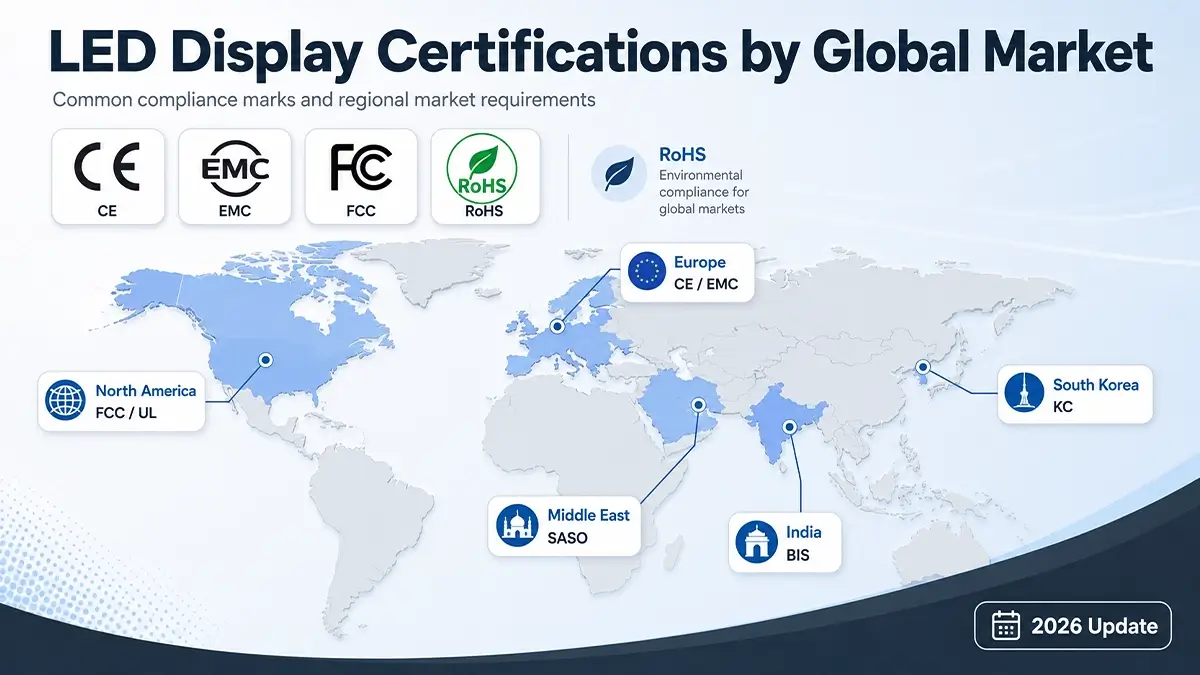
Guía rápida de certificación: Lo que su mercado necesita
Antes de leer el análisis completo, aquí tienes un resumen.
| Market | Imprescindible para aduanas | Los clientes también pueden solicitar | Lo que debes hacer |
|---|---|---|---|
| EU | CE | Clase B de compatibilidad electromagnética (sitios sensibles) | Get the EMC test report — not just the CE certificate |
| India | BIS | - | Confirm your supplier has BIS registration |
| Saudi Arabia | SASO | IECEE/CB | La aduana no hará el despacho sin él. |
| South Korea | KC (fuente de alimentación) | - | Compruebe el certificado KC de la fuente de alimentación, no el de la pantalla. |
Ahora, los detalles, en el orden en que sus clientes realmente preguntan por ellos.
CE — Tu billete a Europa
La certificación CE es la que todo comprador conoce. Si vendes pantallas LED en la UE, la necesitas. Punto.
¿Qué contiene la marca CE?
- LVD (Directiva de baja tensión) — Seguridad eléctrica, con arreglo a la Directiva 2014/35/UE
- EMC (Compatibilidad electromagnética) — Tu pantalla no debería interferir con los equipos cercanos.
- Referencia RoHS — restringe las sustancias peligrosas, en virtud de la Directiva 2011/65/UE.
Esto es lo que importa en la práctica.
CE es una autodeclaración. El fabricante la emite; no hay una auditoría obligatoria de terceros. Eso significa que El certificado por sí solo significa muy poco.. Two factories can both show you a CE certificate. One spent money on a real test lab. The other downloaded a template.
Cuando evalúe a un fabricante de pantallas LED, no pregunte "¿tiene certificación CE?". Pregunte: “can I see the LVD test report and the EMC test report.”
The certificate is just the cover page. The test reports — with lab names, test standards, and measured results — are where real compliance lives or doesn’t.
EMC: La parte de la ingeniería electrónica que realmente cuesta dinero.

La mayoría de los clientes no dicen "Necesito EMC". Dicen "Necesito CE".
But EMC is where the real compliance work happens. It’s also where factories cut corners — because proper EMC testing costs real money and adds design complexity.
Clase A vs. Clase B: La distinción que importa
| Clase A | clase B | |
|---|---|---|
| Donde se aplica | Industrial: fábricas, almacenes | Residential, commercial — offices, malls, retail |
| Límites de emisión | Más flojo | Más estricto |
| Por qué importa | Your screen can radiate more without violating the limit | Must keep interference low enough for mixed-use environments |
| ¿Suficientemente bueno? | Sí, espacio industrial dedicado | Obligatorio: cerca de donde la gente trabaja o vive. |
¿Cuándo importa realmente la clase B de compatibilidad electromagnética?
Tres escenarios en los que a su cliente le importará:
- Vestíbulos corporativos y salas de conferencias. A screen radiating at Class A levels will interfere with laptops, phones, and AV equipment in the same room.
- Comercios minoristas y centros comerciales. For any commercial LED display in a mixed-use building, EU regulations impose strict EMC limits. Class A screens have been flagged during building inspections.
- hospitales y estudios de radiodifusión. These environments have near-zero tolerance for electromagnetic interference.
¿Para una planta de producción o un almacén? La clase A es suficiente. Ahorra dinero.
Cómo comprobar lo que realmente tiene su proveedor
Solicite el informe de la prueba EMC, no un certificado ni un correo electrónico que diga "sí, lo tenemos". El informe. Busque:
- El estándar de prueba (EN 55032 (para equipos multimedia)
- El resultado de la clasificación (Clase A o Clase B)
- ¿Quién realizó las pruebas?TÜV, SGS, or an accredited local lab — the lab name tells you if they paid for a real test)
A factory unwilling to share the actual report is a red flag. The report exists or it doesn’t. There’s no middle ground.
FCC — La puerta de Estados Unidos
FCC is the US equivalent of CE. No FCC, no legal sale into the United States. Customs can — and does — hold shipments without it.
Lo que cubre la FCC: interferencia electromagnética (EMI). Similar a la compatibilidad electromagnética (EMC) en la normativa CE, pero bajo la Parte 15 de la FCC.
Dos cosas que debes saber
- La certificación FCC no es automática para todas las fábricas. Unlike CE, which many Chinese LED display manufacturers obtain as a baseline, FCC requires separate testing and filing. Not all suppliers bother — especially if the US isn’t their primary market.
- La mayoría de las pantallas LED se incluyen en la categoría SDoC. (Supplier’s Declaration of Conformity). This is simpler than full Certification — your supplier self-tests or uses an accredited lab, then files the paperwork. But they still need to do it.
If your project is headed to the US, confirm FCC upfront. Don’t assume it comes with CE. It doesn’t.
RoHS 3.0 — Actualizado para 2026, no siempre obligatorio
RoHS restricts hazardous substances in electronics — lead, mercury, cadmium, and now (as of 2026) four additional phthalates under RoHS 3.0.
El umbral es estricto: ≤0.1% para la mayoría de las sustancias, ≤0.01% para el cadmio.
Esto es lo que nadie te cuenta.
LED display manufacturing involves SMT (surface-mount technology) assembly. Traditional solder contains lead. Lead-free solder exists — but it requires higher reflow temperatures and different process controls. That means:
- Costos de producción más altos
- Menor rendimiento en el primer intento
- Líneas de producción separadas para evitar la contaminación cruzada.
Algunos fabricantes ofrecen productos que cumplen con la normativa RoHS. Muchos otros no lo hacen para pedidos estándar. If they do offer it, expect a premium and a longer lead time.
Qué significa esto para usted como comprador
Cuando su cliente solicita RoHS:
- Pregunte: “¿Es la directiva RoHS un requisito indispensable para este proyecto, o es algo deseable?” If the screen goes into an industrial environment outside the EU, RoHS may not be required.
- If it is required: confirm with your supplier that they can do it at the component level — and verify which components. Power supplies and cables often carry their own RoHS compliance independently.
- Be aware: for non-EU projects that don’t explicitly mandate RoHS, skipping it avoids cost. Most commercial LED display installations worldwide run on standard (non-RoHS) product with zero issues.
Clients who won’t actually need RoHS still ask for it — because it was on an old spec sheet. Your job is to sort which category your project falls into.
UL / ETL — Seguridad norteamericana, principalmente en el cable de alimentación
UL (Underwriters Laboratories) and ETL (Intertek) are North American safety certifications. Your US client may mention them. Here’s what to understand:
UL/ETL se aplica principalmente a componentes eléctricos. — power supplies, cables, connectors. The display panel itself rarely needs a UL mark. What actually matters:
- Fuente de alimentación UL: The internal power supply units should carry UL recognition. Most reputable power supply brands (Mean Well, for example) have this by default.
- Cable y conector UL: Los cables de alimentación y el cableado interno deben contar con la certificación UL.
- Listado UL de visualización completa: This exists. It’s expensive. Very few LED display manufacturers pursue it for standard products — and most projects don’t need it.
Cuando su cliente diga “necesitamos UL”, aclare:
“We have UL on all power components. For full-display listing — is that a specific requirement from your installer or insurer?”
In 90% of cases, power-component UL is sufficient and the client moves on.
Certificaciones regionales: India, Arabia Saudita, Corea
Your client isn’t always in Europe or the US. Regional certifications catch buyers off guard — until customs sends the shipment back.
BIS — India
India’s BIS (Bureau of Indian Standards) registration is mandatory for electronic products. Without it, Indian customs won’t release your LED display. The good news: once a manufacturer has BIS, it covers their product line. Confirm BIS registration before quoting an Indian project. It’s a binary yes/no — either they have it or they can’t ship.
SASO — Arabia Saudita
Saudi Arabia requires SASO certification for all imported electronics. Outdoor LED displays face additional scrutiny — they often need the IECEE/CB scheme on top of SASO.
We shipped an outdoor LED display to Saudi Arabia. The client required full SASO + IECEE/CB compliance. Getting it meant third-party lab testing, factory inspection, document submission in Arabic, and a non-trivial investment of time and money. We did it. The shipment cleared customs without a single delay. If we’d skipped it and hoped for the best — the container would have sat in port, accruing demurrage fees.
Si su proyecto se dirige a Arabia Saudita, pregunte a su proveedor con anticipación: “Do you have SASO? For outdoor — do you have IECEE/CB?” Si la respuesta es una pausa prolongada, busque otro proveedor.
KC — Corea del Sur
South Korea’s KC certification applies to the power supply unit, not the display panel. If your supplier uses power supplies from a manufacturer with KC certification (Mean Well, for instance), you’re covered. Confirm this at the component level.
Guía rápida de comunicación con el comprador

Cuando su cliente le envíe una lista de certificación, así es como debe responder, no con una respuesta genérica. “we have everything,” pero con respuestas que demuestren que entiendes lo que importa.
| El cliente solicita | Tu respuesta |
|---|---|
| CE | “Confirmed. We’ll also share the EMC and LVD test reports so you have the full documentation.” |
| EMC Clase B | “We can provide Class B for certain product lines. If Class A is acceptable for this installation environment, that saves cost. Let me know the site details.” |
| FCC | “FCC is possible but requires separate filing — let me check lead time. Is the project confirmed for the US market?” |
| RoHS | “RoHS compliance is available on request. It does add cost and lead time. Is this a hard requirement for the project?” |
| UL | “All power supplies and cables are UL-listed. Do you need full-display UL listing, or is component-level sufficient?” |
| SASO / BIS / KC | “We have SASO/BIS registration. KC is covered through our power supply supplier. Can share documentation on request.” |
Cómo DOIT VISION maneja las certificaciones
We’ve been exporting LED displays for 15 years. We’ve seen every certification request — the real ones and the ones clients copy-paste from old spec sheets without knowing why.
Esto es lo que realmente aportamos:
LVD under 2014/35/EU, EMC under applicable standards. Test reports available — not just certificates.
Third-party tested, not self-declared. For commercial LED display installations in offices, retail, and mixed-use environments.
Power supplies and cabling carry UL recognition. Covers the electrical safety your installer or insurer actually checks.
Done it for real outdoor projects. We know the paperwork, the timeline, what customs needs.
Los envíos procedentes de la India pasan la aduana sin problemas.
A nivel de componentes, verificado a través de socios proveedores de energía.
If your project requires something we don’t have standard — we’ll tell you. No padding, no generic “we can do everything.” Just an honest answer and, where possible, a path forward.
Send it to us on WhatsApp. We’ll tell you what’s mandatory, what’s optional, and what your supplier might be glossing over.
¿Cuál es la diferencia entre CE y EMC Clase B?
¿Necesito la certificación RoHS para mi proyecto de pantalla LED?
¿Es necesaria la certificación de la FCC para vender pantallas LED en Estados Unidos?
¿Qué certificaciones son obligatorias para el mercado europeo?
¿La certificación UL cubre toda la pantalla LED o solo la fuente de alimentación?
¿Qué certificación necesito para un proyecto de pantallas LED en Arabia Saudita?
¿Cómo puedo verificar si las certificaciones de un fabricante son auténticas?
¿Qué certificaciones posee DOIT VISION?
Analice sus requisitos de brillo.
Cuéntenos qué funciones necesita la pantalla. Podemos sugerirle una configuración cuadrada y confirmar los detalles de brillo y potencia para su presupuesto.
Solicitar cotización