 Televisor LED COB todo en uno
 Pantallas LED flexibles
 Pantallas LED transparentes
 Cartel llevado
 Pantallas LED circulares
 Pantallas LED de columna
 Pantallas LED creativas y personalizadas
GUÍA DE COMPRA DE PANTALLAS LED ANULARES: DIÁMETRO EXTERIOR, ANCHO DE BANDA, PASO DE PÍXELES Y MONTAJE (2026)
A ring LED display — also called a halo LED screen — is a hollow donut-shaped loop with pixels only on the band and an open centre you can see through. Buying one means five decisions in order: outer diameter and band width, pixel pitch, single- or double-sided, framed or frameless, and mounting method. This guide walks through each decision with real project data from ceiling-suspended halos in mall atriums, hotel lobbies, and brand flagships across 55+ countries. New to ring displays? Start with our Ring LED product page for specifications — then return here to build your quote request.
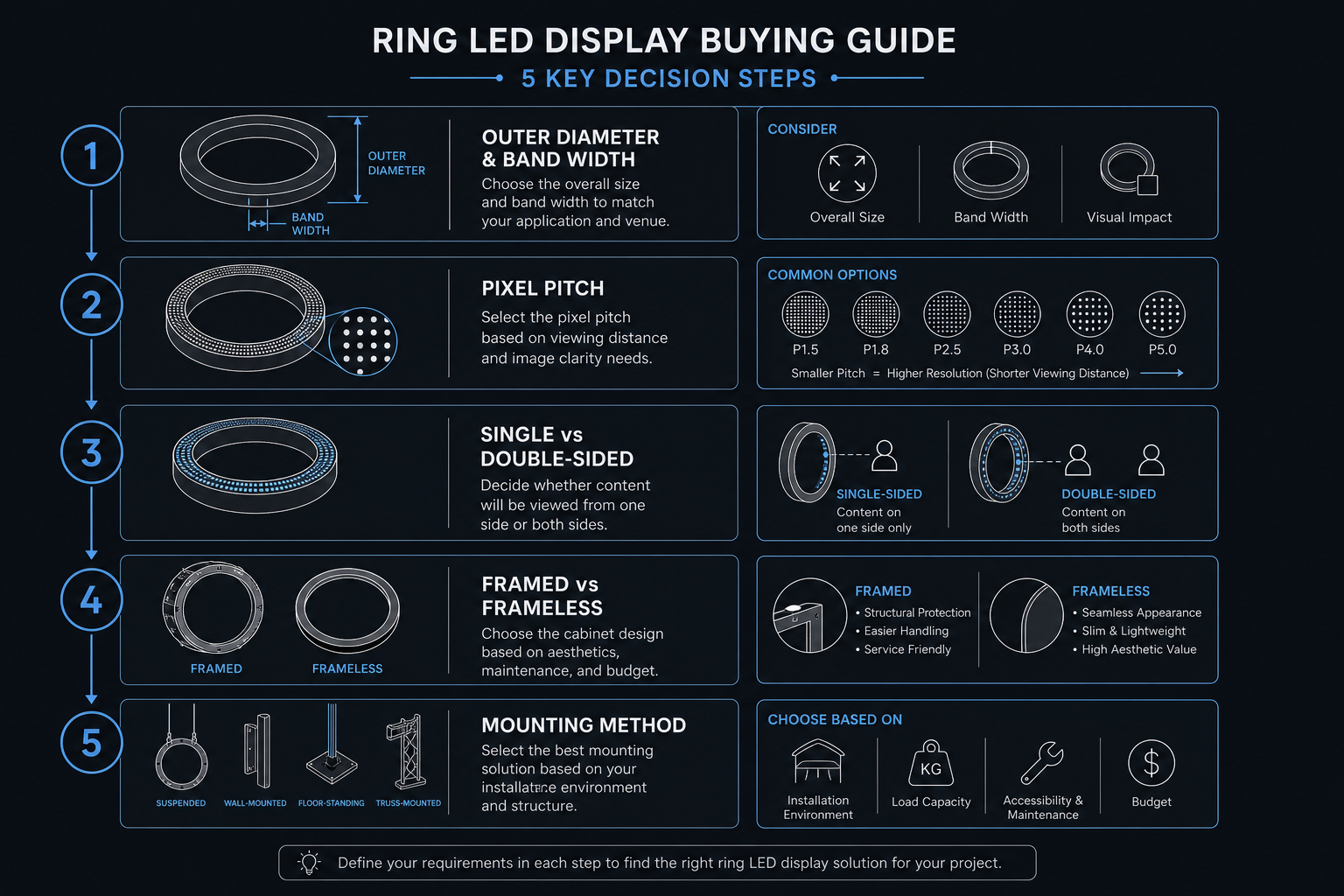
- A ring LED display is not a circular disc and not a cylinder — it is a flat hollow loop (donut/halo shape) with an open centre. If you need a solid round screen, see LED circular. If you need a vertical column wrap, see LED de cilindro.
- Five decisions, in order: (1) outer diameter + band width, (2) pixel pitch, (3) single- vs double-sided, (4) framed vs frameless, (5) mounting method. Each decision constrains the next.
- Outer diameter should be roughly 1/3 to 1/2 of the closest viewing distance — same rule as circular displays. Band width (the pixel strip thickness) determines visual impact: 0.3–0.5m for subtle halos, 0.5–1.0m for statement pieces.
- Pixel pitch rule unchanged: pitch in mm ≈ minimum viewing distance in metres. P2.5 for 2.5m+, P1.57 for 1.5m+, P1.25 for close-up brand zones.
- Double-sided rings cost roughly 60–80% more than single-sided and are standard for ceiling-suspended mall atriums. Single-sided suits wall-mounted retail windows and stage backdrops viewed from one direction.
- Indicative pricing: framed ring 2m outer diameter P2.5 single-sided $5,000–$8,000 EXW Shenzhen; frameless borderless same size $8,000–$12,000. Double-sided adds 60–80% over single-sided.
Ring vs Circular vs Cylinder — Know Which Shape You Need
Search terms overlap, but these are three different products with different structural frames and content mapping workflows. Getting this wrong at specification stage wastes weeks.
- → Flat horizontal loop — one plane, open centre
- → Pixels only on the ring band; centre is empty
- → Ceiling-suspended halos, DJ booth rings, retail window frames
- → Ring LED product page →
- → Solid round disc — pixels fill the entire surface
- → Wall-mounted signage, full-image circular content
- → Heavier than an equivalent ring at the same outer diameter
- → Circular LED product page →
- → Vertical 360° wrap around a column or pillar
- → Viewers walk around the column — not a ceiling halo
- → Different rigging, different content canvas
- → Cylinder LED product page →
If your brief says “ring” but the render shows a solid disc filling the circle, you want circular — not ring. If the render shows a halo with sight lines through the centre, you want ring. For a detailed comparison, read Ring vs Circular vs Cylinder LED.
Decision 1: Outer Diameter and Band Width
A ring display has two size dimensions, not one. Diámetro exterior is the overall span of the halo. Ancho de banda (also called ring thickness) is how wide the pixel strip is — the distance between outer edge and inner opening.
The viewing-distance rule from circular displays still applies: outer diameter should be roughly 1/3 to 1/2 of the closest viewing distance. A 2m outer diameter ring viewed from 6m looks proportional. A 0.8m ring at the same distance looks like a wall clock.
| Sitio | Distancia de visualización | Diámetro externo | Typical Band Width |
|---|---|---|---|
| Retail window / reception counter | 1-2m | 0.5-1.0m | 0.15-0.30m |
| Brand flagship / DJ booth halo | 2-4m | 1.5-3.0m | 0.30-0.50m |
| Hotel lobby / casino ceiling | 4-8m | 2.0-4.0m | 0.40-0.80m |
| Mall atrium (multi-floor) | 6-15m | 3.0-6.0m | 0.50-1.00m |
Minimum outer diameter: 0.3m (300mm) for framed rings using standard flexible modules. Frameless fan-shaped PCB rings typically start at 0.6m outer diameter because custom sector tooling needs sufficient arc length per board.
Inner opening: Defined by outer diameter minus twice the band width. A 3m outer ring with 0.5m band width has a 2m clear opening — performers, merchandise, or architectural elements remain visible through the centre. This is the primary reason integrators choose ring over circular for stage and atrium work.
Nuestros Bangkok 3m suspended borderless ring used a concentric halo array — multiple rings at different diameters clustered at varying heights. Outer ring 3m, frameless borderless construction, ceiling-suspended with steel cable rigging. The open centre preserved vertical sight lines through the atrium while the halo band carried brand animation. Specify whether you need a single ring or a multi-ring array when requesting your quote.
Decisión 2: ¿Qué paso de píxel?
The pixel pitch rule is the same as any LED display: pixel pitch in mm ≈ minimum viewing distance in metres. P2.5 looks sharp at 2.5m and beyond. P1.25 at 1.25m+. Going finer than your viewing distance requires is wasted budget — the extra pixels sit on a narrow band strip where total pixel count is lower than a solid disc anyway.
| Paso | Distancia mínima de visualización | Typical Ring Application |
|---|---|---|
| P1.25 | 1.25m + | Luxury retail halos, close-up brand zones |
| P1.57 | 1.5m + | Hotel lobbies, flagship stores |
| P2.5 | 2.5m + | Mall atriums, DJ booths, stage rings — most common |
| P4 | 4m + | Large atrium halos viewed from upper floors |
Ring content is typically mapped to a band-shaped canvas — logo animation, gradient sweeps, text running around the circumference. Fine pitch matters less than for a solid disc showing detailed photography, because the content is designed for the ring form. P2.5 handles 80% of ring projects.
Utilice el Ring Band Resolution Calculator on our product page to estimate band pixel count from outer diameter, band width, and pitch before specifying your processor.
Decision 3: Single-Sided or Double-Sided?
Single-sided rings have LEDs on one face of the band only. Double-sided rings illuminate both faces on a shared ring chassis — each face has its own receiving card and can run independent content.
- → Lighter — lower rigging load for ceiling suspension
- → Lower cost — one module face per band segment
- → Ideal for: wall-mounted retail windows, stage backdrops, DJ booths viewed from one direction
- → Visible from above and below — mall atriums, multi-floor lobbies
- → ~60–80% heavier than single-sided — rigging must account for weight
- → Two independent content channels on one structure
- → Standard for ceiling-suspended brand halos
Do not specify double-sided for a wall-mounted ring facing one direction — you pay for a second screen nobody sees. For a full engineering comparison of weight, power, rigging, and content workflow, read Anillo LED de una o dos caras.
Decision 4: Framed or Frameless Borderless?
The framed vs frameless trade-off for rings mirrors circular displays, with one addition: frameless rings use custom fan-shaped PCB sectors — the same technology deployed in our Bangkok borderless halo array.
- → Visible aluminium ring chassis encloses module edges
- → Standard flexible modules — lower cost, 15–25 day lead time
- → Easier repair — individual modules replaceable
- → Best for: stage rings, exhibitions, budget retail halos
- → No visible bezel — halo appears to float in space
- → Custom fan-shaped PCB sectors per diameter — 30–50% higher cost
- → 35–45 day lead time including PCB tooling
- → Requires Novastar circular pixel mapping + pre-configured RCFG files
- → Best for: luxury retail, architectural atriums, brand flagships
For circular displays, we wrote a dedicated comparison of framed vs frameless image quality and installation tolerance. The same principles apply to rings — read Framed vs Frameless Circular LED for the engineering detail; ring frameless adds fan-shaped sector PCB layout on top.
Decision 5: Which Mounting Method?
Unlike circular displays that offer five installation methods, rings are dominated by ceiling suspension — but not exclusively. Confirm mounting before production; rear anchor points and cable routing are customised to match.
| Método | Uso típico | Instalar tiempo |
|---|---|---|
| Ceiling-suspended (steel cable) | Mall atriums, hotel lobbies, DJ halos | 4–6 hours, 2 technicians |
| Wall-mounted (flush bracket) | Retail window rings, single-sided | 2-4 horas |
| Floor-standing (pedestal) | Exhibitions, pop-up activations | 1-2 horas |
| Multi-ring array (shared rigging grid) | Concentric halos, casino ceilings | 1–2 days (engineering-dependent) |
For ceiling-suspended rings: 4–8 steel cables rated to 3× display weight, anchored to concrete slab or steel truss with a load-spreading plate. Modules use reinforced neodymium magnets with mechanical lock backup in inverted orientation. Structural load calculations ship with every order. Full rigging guide: How to Install a Ceiling-Suspended Ring LED.
What Does a Ring LED Display Cost?
Ring pricing depends on five variables: outer diameter, band width, pixel pitch, framed vs frameless, and single vs double-sided. Below are indicative EXW Shenzhen prices based on 2023–2025 project data. Every quotation includes a line-by-line BOM.
| Configuration | Ø exterior | Paso | EXW Price (USD) |
|---|---|---|---|
| Framed, single-sided | 1.0m | P2.5 | $ 2,500-$ 4,000 |
| Framed, single-sided | 2.0m | P2.5 | $ 5,000-$ 8,000 |
| Frameless borderless, single-sided | 2.0m | P2.5 | $ 8,000-$ 12,000 |
| Framed, double-sided | 3.0m | P2.5 | $ 12,000-$ 18,000 |
| Frameless, multi-ring array | 3.0m + concentrics | P1.57 – P2.5 | Project quote — see Bangkok case |
Budget an additional 15–25% for shipping, customs duties, and local installation labour. Rigging hardware for ceiling suspension is included in the display quote; structural ceiling reinforcement (if required) is a separate local contractor scope.
Lista de verificación antes de realizar su pedido
-
Outer diameter and band width decidedOuter diameter ≈ 1/3 to 1/2 of closest viewing distance. Band width 0.3–0.5m for subtle halos, 0.5–1.0m for statement pieces. Minimum 0.3m outer for framed; 0.6m for frameless.
-
Pixel pitch matches viewing distanceP2.5 for 2.5m+. P1.57 for 1.5m+. Do not over-specify fine pitch for distant atrium viewing.
-
Single- or double-sided confirmedDouble-sided only if viewers approach from both directions. Adds 60–80% weight and cost over single-sided.
-
Framed or frameless decidedFramed = lower cost, faster lead time. Frameless = floating halo aesthetic, 30–50% premium, custom PCB tooling.
-
Mounting method chosen and ceiling structure documentedProvide ceiling type (concrete slab, steel truss, suspended ceiling) for anchor specification. Confirm power and data access at installation point.
-
CAD mockup received from supplierRequest engineering drawings showing outer/inner diameter, mounting points, module layout, and cable routing before committing.
Send us your five decisions — outer diameter, band width, pixel pitch, sided configuration, framed or frameless, and mounting method. Our engineering team returns a 3D CAD visualisation and line-by-line BOM within 24 hours.
¿Cuál es la diferencia entre una pantalla LED anular y una pantalla LED circular?
What are the five decisions when buying a ring LED display?
What size ring LED display do I need?
What pixel pitch is best for a ring LED display?
Should I choose single-sided or double-sided ring LED?
¿Cuánto cuesta una pantalla LED anular?
What should I confirm before ordering a ring LED display?
Analice sus requisitos de brillo.
Cuéntenos qué funciones necesita la pantalla. Podemos sugerirle una configuración cuadrada y confirmar los detalles de brillo y potencia para su presupuesto.
Solicitar cotización