 Televisor LED COB todo en uno
 Pantallas LED flexibles
 Pantallas LED transparentes
 Cartel llevado
 Pantallas LED circulares
 Pantallas LED de columna
 Pantallas LED creativas y personalizadas
TRANSPARENT LED DISPLAY PRICE: FILM, HOLOGRAPHIC & GRID COST (2026)
“Transparent LED” is three products, not one price list. Película LED — the lowest total installed cost — runs roughly US$740–2,220 per square metre for the film body (EXW Shenzhen), with P10 (the most common) around US$1,120/m². LED holográfico body reference runs US$1,000–4,910/m² (P6.25–P2.5); Cuadrícula transparente corre US$300–960/m² depending on pitch and brightness, with outdoor IP65 from about US$730/m². This guide maps what each route costs, what moves the number, and how to budget before you ask for a quote.
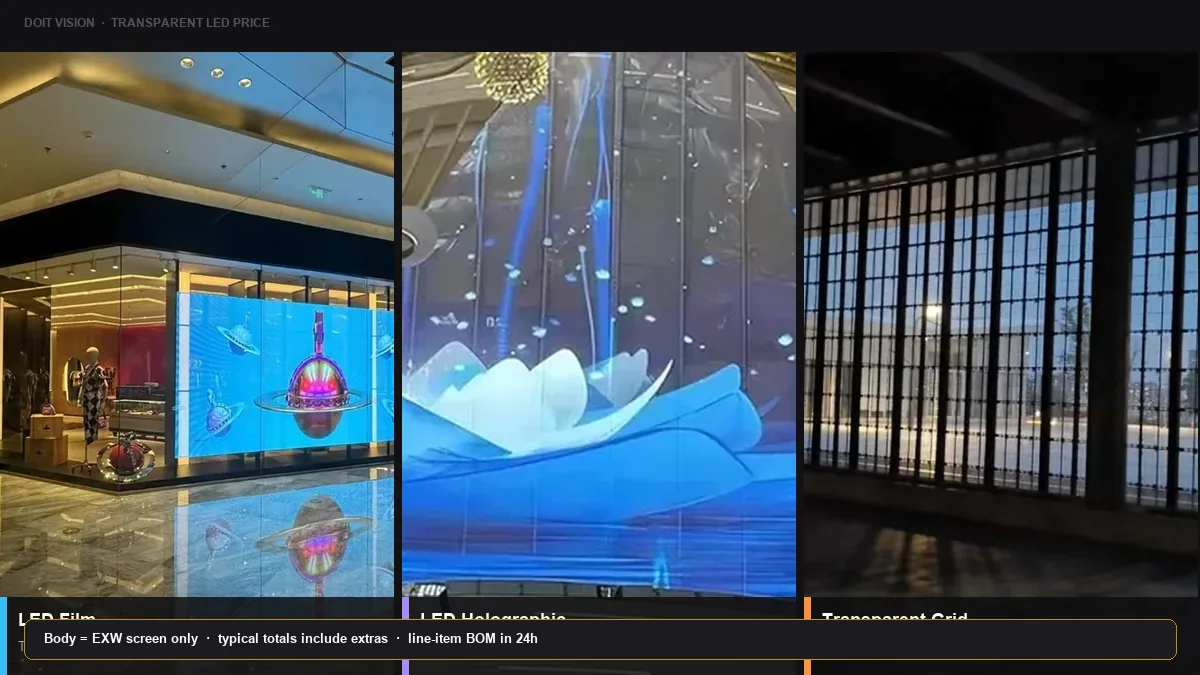
- Three constructions, three price structures. LED Film (US$740–2,220/m²), Holographic (US$1,000–4,910/m²), and Grid (US$300–960/m²) each publish a reference body range (EXW Shenzhen); rigging, brightness tier, and custom cabinet sizes still move the final BOM.
- Installed cost runs Film → Holographic → Grid. Each step adds hardware — no frame, then an aluminum frame, then full cabinets plus rigging.
- Pixel pitch is the biggest lever within any route. Coarser pitch drops the per-m² cost sharply; match pitch to viewing distance, not to a spec sheet.
- The m² price is never the total budget. Controller, cables, install, and shipping add 10–25% on top.
- Only Grid is outdoor-capable (IP65 on request). Film (IP31) and Holographic (IP30) are indoor — budget the right route, not a “weatherproofed” indoor product.
La respuesta honesta primero
There is no single “transparent LED display price,” because the category is three different build methods, not one screen at three quality levels. The honest answer depends on which route fits your glass:
- Película LED — a self-adhesive sheet you stick onto existing glass. Cheapest total installed cost, with a stable published reference range (US$740–2,220/m² body, EXW Shenzhen).
- LED holográfico — an aluminum frame with LED strips for a floating 3D image. Finer pitch and a frame push the body to roughly US$1,000–4,910/m² (P6.25–P2.5, EXW).
- Cuadrícula transparente — modular aluminum cabinets you hang, stack, or bolt on. The structural and daylight route, and the only outdoor-capable one. Body reference US$300–960/m² by pitch and brightness; outdoor IP65 from ~US$730/m².
Film, Holographic, and Grid each have published reference ranges by pitch and brightness tier — so you can budget before you ask. What still moves the final number: glass size, cabinet count, rigging, non-standard cabinet dimensions, order quantity, and destination. The line-item BOM you receive within 24 hours confirms MOQ, lead time, and the exact figure for your glass.
Three Routes, Three Price Structures
At equal area, installed cost rises from Film to Holographic to Grid, because each step adds a structural layer. The table below lines the three routes up side by side so you can see where the money goes in each.
| Ruta | Construcción | Transparencia | Orientación de precios | Acción: |
|---|---|---|---|---|
| Película LED | Self-adhesive sheet on glass | 90-95% | US$740–2,220/m² body · P10 ~US$1,120 (EXW) | LED Film → |
| LED holográfico | Aluminum frame + LED strips | 70-90% | US$1,000–4,910/m² body · P6.25 ~$1,000 · P2.5 ~$4,910 (EXW) | Holographic → |
| Cuadrícula transparente | Modular aluminum cabinets | 40-80% | US$300–960/m² body · 5500 nits ~$540–960 · outdoor IP65 ~$730–750 | Grid → |
For a deeper read on Film’s per-pitch numbers, see Transparent LED Film Screen Price. For the full technical side-by-side on transparency, brightness, and pitch, read Film vs Holographic vs Grid.
¿Qué es lo que realmente determina el precio?
Five things move the number, in rough order of impact:
- La Construcción. The biggest structural lever. Film carries no frame; Holographic adds an aluminum frame and strip density; Grid adds full cabinets plus rigging. That layering, not pixel quality, is why installed cost climbs across the three.
- Tamaño de píxel. Within any route, finer pitch means denser LEDs and a higher per-m² price. Going from P5 to P10 on Film can nearly halve the unit cost. Pitch in millimetres ≈ minimum viewing distance in metres.
- Brillo. Grid reaches up to 5,000 nits for sun-facing façades; Film spans 2,000–4,000 nits (P5 around 2,500); Holographic is about 3,500 nits. Higher brightness raises the BOM — specify it only where daylight demands it.
- Área de la pantalla. Transparent LED prices per square metre, so cost scales near-linearly with area — but larger orders often unlock a better unit rate.
- Personalización. Custom-cut panels, curved glass, and non-standard shapes add engineering and lead time. Standard rectangular runs are the cheapest path.
Running cost tracks power density, not just the purchase price: Film draws max 600 / avg 200 W/m², Holographic 800 / 230, Grid 800 / 240. Sparse transparent content — text, logos, short motion — keeps real draw well below peak.
Budget by Project Type
Work backward from the install situation to find the right route, then budget within it:
| Proyectos | Ruta | Orientación presupuestaria |
|---|---|---|
| Retail storefront window | Película LED | Small windows (10–15 m²) roughly US$12,000–21,000 total |
| Hotel lobby / museum floating wall | LED holográfico | Lobby walls (15–30 m²) roughly US$15,000–147,000 body · finer pitch at top of range |
| Large façade / curtain wall, direct sun | Cuadrícula transparente | Large façades (50–100 m²) roughly US$15,000–96,000 body at 5500 nits · + rigging/install |
| Weather-exposed outdoor advertising | Transparent Grid (IP65) | The only outdoor route — specify IP65 at quotation |
The tie-breaker is always the glass situation. Adhesive routes (Film, Holographic) assume existing glass to stick to; no glass, or glass facing direct sun, points to Grid. For a full walk through where transparent LED earns its cost and where it’s the wrong tool, read Use Cases & When Not to Use.
The Hidden Costs (Beyond the Screen)
The screen body is the largest line item, but not the only one. Budget for these before you compare quotes, otherwise two suppliers’ “per m²” prices are not comparable:
| Parámetro | Rango típico | Notas |
|---|---|---|
| LED controller (Novastar / Colorlight) | US $ 300 - 600 | Configured to your panel layout before shipping |
| Cables de alimentación y de señal | US $ 200 - 500 | Depends on run length and site layout |
| Mano de obra de instalación | Por región | Film is fastest (no frame); Grid needs rigging |
| Shipping & import duty | Por destino | Quoted to your port |
These extras typically add 10-25% on top of the screen body. The structural savings are why Film is the cheapest transparent route: a two-person crew installs 20–30 m² per day with no steel and no glass replacement.
How to Choose & Get a Real Quote
Ask what you’re attaching to. Vidrio existente → Film (max see-through) or Holographic (floating image). No glass, a sun-facing wall, or outdoor exposure → Grid. Confirm what must stay visible behind the screen, and you’ve already cut the list to one.
Then get the number the honest way — send three details and an engineer returns a line-item BOM within 24 hours:
- Glass / wall dimensions (width × height, and whether it’s curved)
- Distancia de observación (how close viewers stand — this sets pitch)
- Interior o exterior (and quantity)
Every line item is listed separately, so you can see exactly where the money goes before you commit. Start from the Transparent LED category page to shortlist, then request the quote.
Send the glass dimensions, viewing distance, and indoor/outdoor — an engineer returns a route recommendation and a line-item quote within 24 hours. No obligation.
¿Cuánto cuesta una pantalla LED transparente?
What is the cheapest transparent LED display?
Why is there no single price for transparent LED?
What drives the price difference between film, holographic, and grid?
How do I budget for a storefront, lobby, or façade project?
Is transparent LED cheaper than a regular LED wall?
What hidden costs are there beyond the screen body?
How do I get an accurate transparent LED quote?
Analice sus requisitos de brillo.
Cuéntenos qué funciones necesita la pantalla. Podemos sugerirle una configuración cuadrada y confirmar los detalles de brillo y potencia para su presupuesto.
Solicitar cotización