 Televisor LED COB todo en uno
 Pantallas LED flexibles
 Pantallas LED transparentes
 Cartel llevado
 Pantallas LED circulares
 Pantallas LED de columna
 Pantallas LED creativas y personalizadas
4 modos de visualización LCD comunes: TN, IPS, VA, FFS
TN, IPS, VA and FFS control liquid crystals in different ways. Their operating principles help explain viewing angle, contrast and motion behavior, but model specifications still matter.
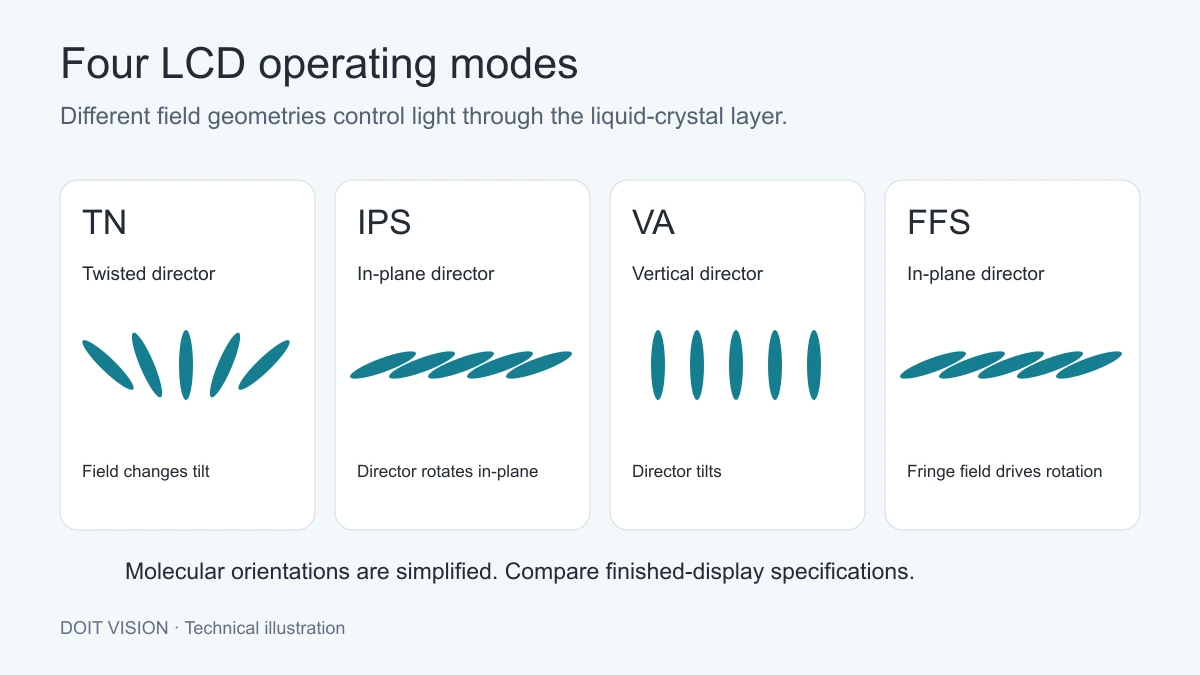
La tecnología LCD se basa en el efecto de birrefringencia de las moléculas de cristal líquido. Según el estado de movimiento molecular, las pantallas LCD se clasifican en cuatro modos principales:
Nematic torcido
IPS (conmutación en el plano)
VA (alineación vertical)
FFS (Conmutación de Campo Marginal)
Do you know the display principles and key characteristics? DOIT VISION will guide you these details.
Relacionados: LCD wall upgrade to LED wall cost.
4 modos de visualización LCD comunes:
TN Mode (Twisted Nematic)
TN is an established LCD mode using a twisted liquid-crystal layer. Descriptions such as “soft screen” are informal and should not be treated as mechanical-durability ratings.
Principio de visualización:
No Voltage Applied: Natural light from the backlight passes through the lower polarizer, becoming linearly polarized light. This light enters the liquid crystal cell. Due to the alignment layers (PI) on the inner surfaces of the upper and lower glass substrates, the liquid crystal molecules twist by 90 degrees from bottom to top.
A medida que la luz polarizada se propaga a través de la célula, su dirección de polarización gira sincrónicamente con las moléculas. Cuando esta luz polarizada llega al polarizador superior, su dirección ha girado 90 grados, alineándose paralelamente al eje óptico del polarizador superior. En consecuencia, la luz se transmite y la pantalla LCD se ilumina (estado ON).
Voltage Applied (Vertical Electric Field): The interaction between the dielectric anisotropy of the liquid crystals and the applied electric field disrupts the twisted structure. The long axes of the liquid crystal molecules align parallel to the electric field direction. The polarization direction of the incoming linearly polarized light no longer rotates. When this light reaches the upper polarizer, its polarization direction is perpendicular to the polarizer’s optical axis, preventing light transmission. Consequently, the LCD appears dark .
En resumen, los paneles en modo TN se muestran brillantes (ENCENDIDOS) cuando no se aplica voltaje y oscuros (APAGADOS) cuando se aplica voltaje. Debido a que la pantalla normalmente se muestra brillante sin voltaje, se denomina modo normalmente blanco (NW).
Limitación del ángulo de visión:
The TN mode relies on a vertical electric field, causing the long axes of the liquid crystal molecules to tilt vertically. So, it creates significant differences in optical path length when viewed from different angles. Consequently, the display appearance varies greatly depending on the viewer’s position, with the most accurate image only seen directly head-on. While viewing angle compensation films can partially mitigate this issue, TN panels always have an optimal viewing direction, typically described as the 6 o’clock or 12 o’clock position.
Ventajas:
Fast Response Time: TN designs can offer fast transitions and remain relevant where motion performance and cost are priorities. Response depends on the panel, transition and drive settings; it is not a direct consequence of having fewer color levels.
Lower Cost: The manufacturing process is relatively simple, mature, and cost-effective. Therefore, TN is suitable for prioritizing cost over ultimate image quality application.
Power Consumption: Compare the finished display at equal luminance. Backlight efficiency, screen size, refresh rate and electronics can outweigh any simple power ranking by LCD mode.
Desventajas:
Limited Viewing Angles: TN panels suffer from narrow viewing angles, especially in the vertical direction. Color shifts, contrast reduction, brightness changes, and image distortion are common when viewed off-axis.
Color Reproduction: Some TN panels use 6-bit driving with temporal dithering to represent additional shades. Native 6-bit RGB has 262,144 combinations, but the complete display may accept an 8-bit signal. Panel mode alone does not determine color accuracy, gamut or bit depth; check these separately.
Contrast Ratio: TN often offers less native contrast than VA. The actual ratio depends on the panel and measurement conditions. Compare static contrast separately from dynamic-backlight claims, and inspect black level in the intended room.
Posición de mercado:
TN remains an option in cost-sensitive and speed-focused applications. Its off-axis limitations can make it a weaker fit for shared viewing or color-critical work. Select from current model specifications instead of assuming that all TN products belong to one price or quality tier.
Modo IPS (Conmutación en el plano)
IPS means In-Plane Switching. It rotates the liquid-crystal director largely within the plane of the substrates and is widely used where stable off-axis images matter. The informal term “hard panel” does not establish impact resistance or service life. IPS has multiple implementations, so contrast, response time and color capability still need model-level comparison.
Principio de visualización:
No Voltage Applied: Natural light from the backlight passes through the lower polarizer, becoming linearly polarized light aligned with the polarizer’s axis. In the absence of voltage, the liquid crystal molecules remain in their initial state and do not rotate the light’s polarization plane. Consequently, when this polarized light reaches the upper polarizer, its polarization direction is perpendicular to the optical axis of the upper polarizer. The upper polarizer blocks the light, resulting in the LCD appearing dark (OFF state).
Voltage Applied: An in-plane electric field rotates the liquid-crystal molecules within the substrate plane. This changes the layer’s optical retardation and the light transmitted through the polarizers. The action is more accurately described this way than as a fixed 90-degree rotation of every light ray.
The changing retardation allows different amounts of light to pass through the analyzer. By varying the applied voltage, IPS panels regulate transmission to produce gray levels; color filters form the RGB subpixels.
En resumen, los paneles IPS permanecen oscuros (apagados) cuando no se aplica voltaje y brillantes (encendidos) cuando se aplica. Debido a que la pantalla normalmente está oscura sin voltaje, se denomina modo Normalmente Negro (NB).
Rendimiento del ángulo de visión:
The predominantly in-plane molecular motion helps IPS maintain more consistent color and contrast at oblique angles than many TN implementations. Off-axis changes can still occur, especially with dark content. A broad quoted angle is not a promise that every color remains identical throughout that range.
Ventajas:
Ángulos de visión excepcionales: Los paneles IPS mantienen imágenes nítidas y una reproducción precisa del color en amplios ángulos de visión, tanto horizontal como verticalmente.
Color Capability: An 8-bit RGB signal has 256 values per channel, or about 16.77 million combinations. IPS panels are available with different native depths and dithering approaches. The LCD mode helps explain viewing behavior, while calibration, gamut and signal processing determine the actual color result.
Commercial Operation: Check operating-hour ratings, static-content guidance, cooling and warranty for the finished display. Neither IPS nor another panel label guarantees service life or resistance to physical damage. This matters for reception displays and monitoring walls used for long periods.
Desventajas:
Lower Native Contrast Ratio: Many IPS panels have lower native contrast than VA designs. Compare measured model data; there is no single contrast ratio shared by every IPS panel. Local dimming can change the complete display’s behavior independently of the underlying LCD mode.
IPS Glow and Backlight Bleed: IPS glow is an angle-dependent brightening most noticeable in dark scenes. Backlight bleed is unwanted light leakage or nonuniformity and is a different issue. Inspect dark imagery from the planned seats at a realistic brightness setting.
Higher Cost: Due to more complex manufacturing processes, IPS panels typically command higher prices than TN panels.
Modo VA (Alineación Vertical)
VA can provide strong native contrast because its vertically aligned off-state helps block light between crossed polarizers. It still uses alignment structures; its contrast advantage is not caused by having no alignment layer. Actual contrast depends on the cell, optical films and complete backlight design.
VA mode panels represent another major mainstream display technology. It is primarily used in large-size televisions and curved screens. The VA category can be further subdivided into types like MVA, PVA, PSVA, and UV2A.
Principio de visualización:
No Voltage Applied: In the absence of voltage, liquid crystal molecules align vertically. Natural light from the backlight passes through the lower polarizer, becoming linearly polarized light. Due to the vertical molecular alignment, the polarization direction of this light remains unchanged. When it reaches the upper polarizer, its polarization direction is perpendicular to the polarizer’s optical axis, blocking light transmission. Consequently, the LCD appears dark (OFF state).
Voltage Applied: The electric field causes the molecules to tilt away from their initial vertical alignment. The degree and direction of tilt change the optical retardation and transmission through the crossed polarizers. The molecules need not become perfectly horizontal, nor does every operating state correspond to a fixed 90-degree light rotation.
Changing the voltage changes the amount of transmitted light, producing different gray levels. Multi-domain designs arrange the tilt directions to improve viewing behavior. Color filters and the control electronics complete the color image.
En resumen, los paneles VA están oscuros (apagados) cuando no se les aplica voltaje y brillantes (encendidos) cuando se les aplica voltaje. Debido a que la pantalla normalmente está oscura sin voltaje, se denomina modo normalmente negro (NB).
Rendimiento del ángulo de visión:
VA implementations can use multiple domains to balance viewing behavior in different directions. Their number and structure vary by design. This improves performance compared with a simple single-domain arrangement, but off-axis gamma and color shifts still need inspection in a wide seating layout.
Ventajas:
High Contrast Ratio: VA designs often produce deeper native blacks than conventional IPS or TN at comparable settings. This can help dark-room imagery. Check measured contrast and bright-scene behavior for the particular display rather than adopting a universal 3000:1 threshold.
Wide Viewing Angles: While viewing angles are generally slightly narrower than those of IPS panels, VA technology still offers significantly wider and more stable viewing angles than TN panels.
Color Reproduction: VA displays can offer rich colors, but their native bit depth, gamut and accuracy are separate specifications. As with IPS, an 8-bit RGB signal provides about 16.77 million code combinations. Check calibration and off-axis color as well as the accepted signal format.
Desventajas:
Tiempos de respuesta más lentos: En comparación con los paneles TN y algunos paneles IPS de respuesta rápida, los paneles VA generalmente presentan tiempos de respuesta de píxeles más lentos, especialmente en las transiciones de gris a gris. Esto puede provocar desenfoque de movimiento o artefactos de imagen fantasma en contenido de alta velocidad.
Power Consumption: Whole-display power depends heavily on the backlight, brightness, area and electronics. Molecular drive voltage alone is not a reliable basis for ranking the energy use of TN, IPS and VA monitors.
Potential Uniformity Issues: Achieving perfect screen uniformity can be challenging with VA panels. You may encounter Issues like color shift. It be more noticeable compared to other technologies, especially off-axis.
Modo FFS (Conmutación de Campo Franja)
FFS, or Fringe Field Switching, developed from the family of in-plane LCD approaches. In a typical FFS structure, patterned electrodes and an underlying common electrode are separated by an insulating layer. The resulting fringe field can control molecules above the electrodes as well as between them, improving use of the available pixel area.
FFS is designed to improve light transmission while retaining wide-angle behavior. Higher transmission can help a display reach a given luminance with less backlight output, although total power depends on the complete product. FFS does not inherently eliminate mura or guarantee perfect uniformity and color accuracy. See E Ink’s technical account of FFS development.
Diferencia clave con respecto a IPS:
En el modo IPS convencional, la aplicación de voltaje rota principalmente las moléculas de cristal líquido ubicadas entre los electrodos. En el modo FFS, la aplicación de voltaje rota las moléculas de cristal líquido tanto entre los electrodos como directamente sobre ellos debido al campo de franjas generado.
Ventajas:
Alta relación de transmitancia/apertura: FFS utiliza electrodos transparentes, maximizando la relación de apertura de píxeles. Esto aumenta significativamente la transmitancia del panel en comparación con los paneles IPS estándar.
Wide Viewing Angles: Fringe-field control supports stable off-axis performance. Compare the actual implementation with other wide-angle LCD designs; FFS does not guarantee a wider usable angle than every IPS model.
Menor consumo de energía: La mayor transmitancia se traduce directamente en un menor brillo de retroiluminación necesario para lograr la misma luminancia en pantalla, lo que reduce el consumo total de energía.
Desventajas:
Higher Production Costs: FFS manufacturing involves relatively complex processes requiring high-precision equipment and strict process control. So it needs higher production costs compared to basic IPS or TN.
Response Time Trade-off: While excelling in transmittance and viewing angles, FFS panels can sometimes exhibit slightly slower response times than optimized TN or some advanced IPS variants. This may impact the clarity of fast-moving images, potentially causing subtle motion blur.
Summary comparison of TN, IPS, VA and FFS
The table describes common tendencies, not guaranteed specifications. Normally white or black refers to the simplified constructions explained above; optical variants exist.
Desplácese horizontalmente para ver todas las columnas en una pantalla pequeña.
| Elemento | TN | IPS | VA | FFS |
|---|---|---|---|---|
| Comportamiento de visualización | Often more angle-sensitive | Generally stable off-axis | Check off-axis gamma | Generally stable off-axis |
| Contraste nativo | Dependiente del modelo | Often below VA | A menudo una fortaleza | Dependiente del modelo |
| Profundidad del color | Check native depth and dithering | Check native depth and dithering | Check native depth and dithering | Check native depth and dithering |
| Response time | A menudo rápido | Fast variants available | Some dark transitions can be slow | Model and transition dependent |
| Apariencia negra | Check from actual seats | Inspect glow in dark scenes | Often strong head-on | Check from actual seats |
| Transmisión | Dependiente del diseño | Dependiente del diseño | Dependiente del diseño | Improved transmission is a design aim |
| Potencia | Compare at equal luminance | Compare at equal luminance | Compare at equal luminance | Transmission can reduce backlight load |
| Costo | Often cost-oriented | Amplio rango de precios | Amplio rango de precios | Depende de la implementación |
| Los usos más comunes | Monitors and embedded displays | Monitors, tablets and shared displays | Televisores y monitores | Mobile and other wide-angle displays |
| Fortaleza clave | Velocidad y costo | Viewing consistency | Contraste nativo | Transmission and viewing behavior |
| Comprobación de claves | Off-axis image changes | Contrast and glow | Dark transitions and off-axis gamma | Uniformity and response |
| Typical off-state | Normally white example | Normally black example | Normally black example | Normally black example |
| Field approach | Predominantly vertical | En plano | Predominantly vertical | Campo periférico |
Conclusión:
TN, IPS, VA and FFS describe how an LCD modulates a backlight. Choose among them using viewing geometry, contrast, motion and color requirements. When a project grows into a multi-panel wall, also compare bezel visibility, total canvas size, service access and content resolution. These system questions are where a direct-view LED alternative becomes relevant.
When to compare an LCD wall with direct-view LED
The four LCD modes explain panel behavior; they do not by themselves decide the best technology for a whole wall. For a larger installation, compare bezel interruptions, nearest viewing distance, small-text readability, total pixel count and access for maintenance. A single LCD and a modular LED wall solve different size and installation problems.
With LED, match pixel pitch and module layout to the physical canvas and content. With an LCD wall, account for panel borders and the resulting content layout. In both cases, evaluate brightness, reflections and off-axis viewing in the real room.
Utilice el Guía para videowalls LED to review the system choice, and the LCD-to-LED upgrade cost guide to organize the budget. Bring existing panel dimensions, source resolution and a site photo to a project discussion.
Pasaremos al siguiente paso a definir las dimensiones de la pantalla, las distancias de visualización, el contenido y las condiciones de instalación.
What are the four common LCD display modes?
¿IPS siempre es mejor que TN?
Why can VA panels have stronger native contrast?
How is FFS different from conventional IPS?
Is IPS glow the same as backlight bleed?
When should an LCD wall be compared with direct-view LED?
Analice sus requisitos de brillo.
Cuéntenos qué funciones necesita la pantalla. Podemos sugerirle una configuración cuadrada y confirmar los detalles de brillo y potencia para su presupuesto.
Solicitar cotización