 Televisor LED COB todo en uno
 Pantallas LED flexibles
 Pantallas LED transparentes
 Cartel llevado
 Pantallas LED circulares
 Pantallas LED de columna
 Pantallas LED creativas y personalizadas
QLED vs UHD: No son rivales: uno es un panel, el otro es una resolución.
QLED and UHD describe different properties. A screen can be both: QLED concerns display technology, while 4K UHD specifies a 3840 × 2160 pixel resolution.
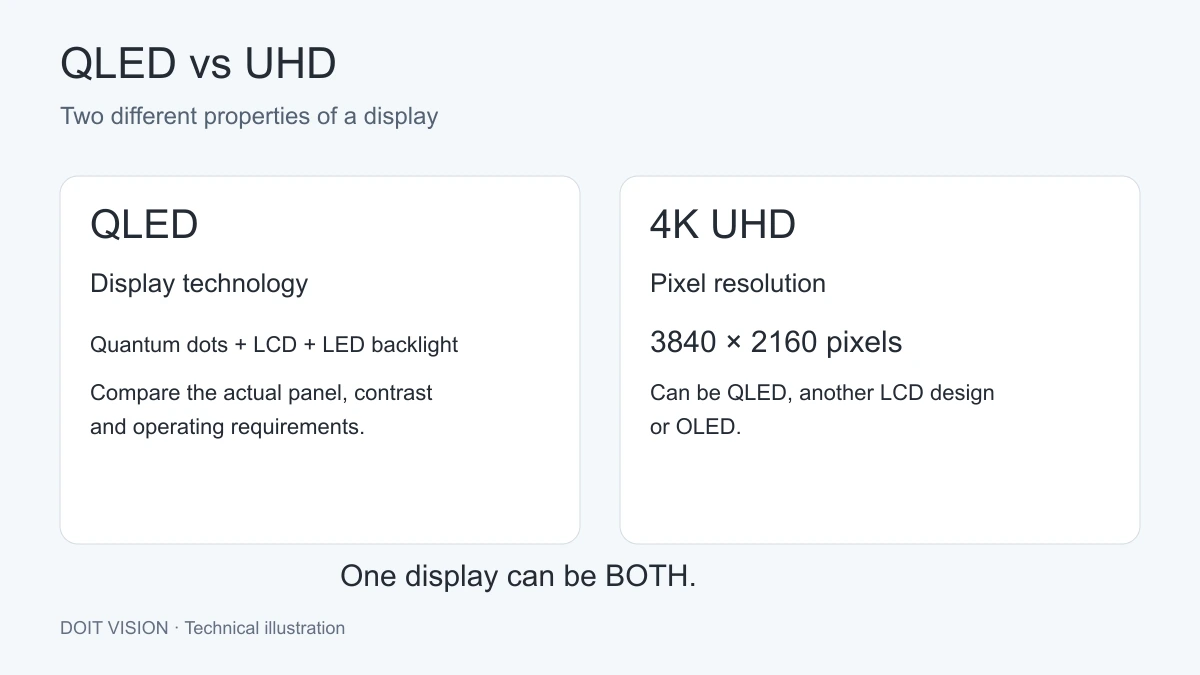
If you’re shopping for a new TV or display screen, you’ve likely heard the terms “QLED” and “UHD.” QLED describes a display technology; UHD describes resolution. A display can be both. Compare the actual panel, brightness, contrast and operating requirements rather than treating the two labels as competing products.
QLED vs UHD: Descripción general básica de las tecnologías
¿Qué es QLED?
QLED stands for Quantum Dot Light Emitting Diode. In the televisions commonly sold under this name, an LED backlight illuminates an LCD panel with a quantum-dot layer to improve color reproduction. QLED should be distinguished from direct-view LED walls, where LED pixels form the image themselves. Samsung explains its QLED construction here.
Características principales de QLED:
- Los puntos cuánticos pueden admitir una gama de colores más amplia.
- Brightness depends on the backlight and operating mode
- HDR performance also depends on contrast and tone mapping
- Check operating hours and warranty for the intended use
- Evaluate reflections in bright environments
¿Qué es UHD?
UHD significa Ultra Alta Definición, que se refiere a un estándar de resolución de 3840 x 2160 píxeles, comúnmente conocido como 4K. Los televisores UHD ofrecen cuatro veces la resolución de las pantallas Full HD (1080p), lo que resulta en imágenes más nítidas y detalladas. Sin embargo, UHD se centra más en la resolución que en la tecnología de visualización. UHD se puede encontrar en varios tipos de pantallas, como LED, OLED y QLED.
For larger canvases, see Paredes de video LED.
Características principales de UHD:
- Resolución 4K (3840 x 2160 píxeles)
- Improved sharpness and clarity
- Standard for most modern TVs
- Suitable for large screens
- Wide content availability, including streaming services
Precisión del color y brillo: QLED frente a UHD
Quantum dots can help a QLED LCD reproduce a wide range of colors at useful brightness levels. Actual color accuracy depends on calibration, picture mode, panel characteristics and the source. Compare named models at similar settings rather than assuming that a technology label automatically produces more accurate colors than a resolution label.
UHD does not specify brightness or color accuracy. OLED UHD, QLED UHD and other LCD UHD models can differ substantially. Check sustained brightness, reflections and measured color performance for your room. HDR results also depend on black level and tone mapping, not just a bright backlight.
Contraste y niveles de negro: UHD vs QLED
OLED UHD displays can switch off individual emitting pixels, producing very deep blacks. QLED LCDs use a backlight; the achievable contrast depends on the panel and any local-dimming system. A high-performance local-dimming model and a basic edge-lit model can behave very differently even though both carry a QLED label.
For a bright room, compare screen reflections and sustained brightness as well as black level. For dark-room viewing, inspect shadow detail and halos around bright objects. Neither UHD resolution nor the QLED name alone guarantees the better result for both environments.
Ángulos de visión: QLED vs UHD
A useful viewing angle maintains acceptable brightness, contrast and color for the people sitting away from the center. QLED LCD performance depends on its LCD mode and optical design. UHD itself has no viewing-angle specification, since it can be implemented with different panel technologies.
OLED displays generally offer stable off-axis imagery, while some LCD designs need closer inspection from side seats. For a large room, test the actual model from the outermost intended seats. Reflections and the angle at which text is viewed also affect readability, even when a panel has a wide quoted viewing angle.
Eficiencia energética: QLED frente a UHD
Power consumption varies with screen size, brightness, picture mode and content. OLED’s self-emitting pixels can consume less power on dark images, while bright full-screen content changes the comparison. QLED LCDs consume power in their backlights, and local-dimming behavior varies by model.
Compare rated and measured consumption at the same screen area and luminance. For a commercial installation, include daily operating hours and the rest of the playback system. A blanket claim that every UHD OLED is more efficient than every QLED would not be reliable.
Durabilidad y longevidad: UHD frente a QLED
For long-running signage, check the display’s operating-hour rating, warranty and static-image guidance. OLED can develop permanent image retention with some usage patterns; LCD has different aging and uniformity considerations. QLED does not guarantee a particular service life, and UHD makes no durability claim at all.
A screen showing changing films at home has a different duty cycle from a reception display showing a fixed logo all day. Ask about the intended use, thermal conditions, brightness setting and service arrangements. Commercial signage models may offer operating features and warranty terms that differ from consumer televisions.
Consideraciones de precio para QLED y UHD
Price depends on model, size, backlight, processing and commercial features. UHD products exist across many price bands, including QLED and OLED models. Compare similarly sized products and complete installation costs; the names alone do not establish a fixed price order.
For a budget comparison, include mounting, control, playback and any commercial operating requirements. A premium model may justify its cost through measured performance or integration features, but compare these explicitly instead of relying on the QLED or UHD label.
Aplicaciones de las tecnologías de visualización QLED y UHD
Aplicaciones de la tecnología de pantalla UHD
UHD displays are widely used in various industries beyond home entertainment. They are commonly found in commercial settings, including digital signage, video walls, and professional content creation. The high resolution makes them suitable for clear, detaiLED displays businesses, like airports, retail spaces, and corporate boardrooms.
Aplicaciones de la tecnología de pantalla QLED
QLED displays appear in home entertainment and commercial spaces such as showrooms. For bright environments, check reflections and sustained luminance. A quantum-dot layer can contribute to wide color reproduction, while the complete model determines HDR performance and suitability for long daily operation.
Usos híbridos (ambas tecnologías)
Some applications, such as broadcasting, live events and architectural visualization, need both suitable resolution and controlled color reproduction. A QLED UHD display combines those two labels in one product; it is not a separate hybrid technology. Medical imaging requires application-specific validation beyond either label.
Características especiales e innovaciones
Características principales de QLED
- Quantum dots for vibrant colors
- Model-specific brightness capability
- HDR capability depends on the complete display
- LCD construction with an LED backlight
- Service life depends on the model and operating conditions
Características principales de UHD
- 4K resolution for sharp images
- Available in OLED, LED, and QLED formats
- Great for large screen sizes
- Wide content support
- Versatile for different use cases
QLED vs UHD: Tabla comparativa
Desplácese horizontalmente para ver todas las columnas en una pantalla pequeña.
| Elemento | QLED | UHD |
|---|---|---|
| Significado | Quantum-dot LCD technology in typical QLED TVs | Resolution designation; commonly 3840 × 2160 for 4K UHD |
| Color y brillo | Depend on quantum dots, backlight and calibration | Not specified by resolution alone |
| Comparación | Depends on LCD panel and local dimming | Depends on the underlying display technology |
| Ángulo de visión | Depends on panel and optical design | Not specified by resolution alone |
| Durabilidad | Check operating rating and warranty | Check the actual display model |
| Energía | Compare at equal size and luminance | Compare at equal size and luminance |
| Precio | Varía según el modelo y la instalación. | Available across multiple technology and price bands |
| ¿Pueden aplicarse ambas? | Yes, a QLED TV can be UHD | Yes, UHD can be QLED, other LCD or OLED |
Conclusión:
When choosing a display, start with your content, room lighting, seating layout and budget. Then compare actual models. Quantum dots, local dimming or an emissive panel affect picture behavior, while UHD resolution affects the available pixel count. Evaluate both dimensions before choosing.
For a single television-sized screen, a suitable UHD LCD or OLED may meet the requirement. For a larger continuous canvas, unusual proportions or a modular installation, compare a direct-view LED wall using physical dimensions, pixel pitch, viewing distance and maintenance access. Those are different purchasing decisions, even when both systems show the same UHD source.
Relacionados: HDR, SDR and DisplayHDR 400 explained.
When the project needs a larger LED canvas
A single UHD television may suit a small meeting room or shop display. A larger shared canvas introduces other requirements: total image dimensions, viewing distance, bezel visibility, service access and the content pixel map. This is the point to compare a Videowall LED de visión directa.
For an LED wall, resolution is calculated from the module layout and pixel pitch. Sending a 4K signal does not automatically make the wall a native 4K display. Agree whether the content will scale, crop or map one-to-one, and check fine text at the nearest and farthest audience positions.
Bring the available wall dimensions, audience distances, daily operating hours and source content to that comparison. The Calculadora con pantalla LED can help explore dimensions before a project review.
Pasaremos al siguiente paso a definir las dimensiones de la pantalla, las distancias de visualización, el contenido y las condiciones de instalación.
Is QLED better than UHD?
Can a QLED television also be 4K UHD?
How is QLED different from OLED?
Which costs more, QLED or UHD?
Is QLED the same as a direct-view LED wall?
Does sending a UHD signal make an LED wall 4K?
Analice sus requisitos de brillo.
Cuéntenos qué funciones necesita la pantalla. Podemos sugerirle una configuración cuadrada y confirmar los detalles de brillo y potencia para su presupuesto.
Solicitar cotización