 Televisor LED COB todo en uno
 Pantallas LED flexibles
 Pantallas LED transparentes
 Cartel llevado
 Pantallas LED circulares
 Pantallas LED de columna
 Pantallas LED creativas y personalizadas
HDR400 vs HDR10: HDR400 es el modelo básico: ¿cuáles son las diferencias?
HDR and SDR differ in how they represent light and color. HDR10 is a content format; DisplayHDR 400 is a monitor certification tier. Neither is a synonym for 4K.
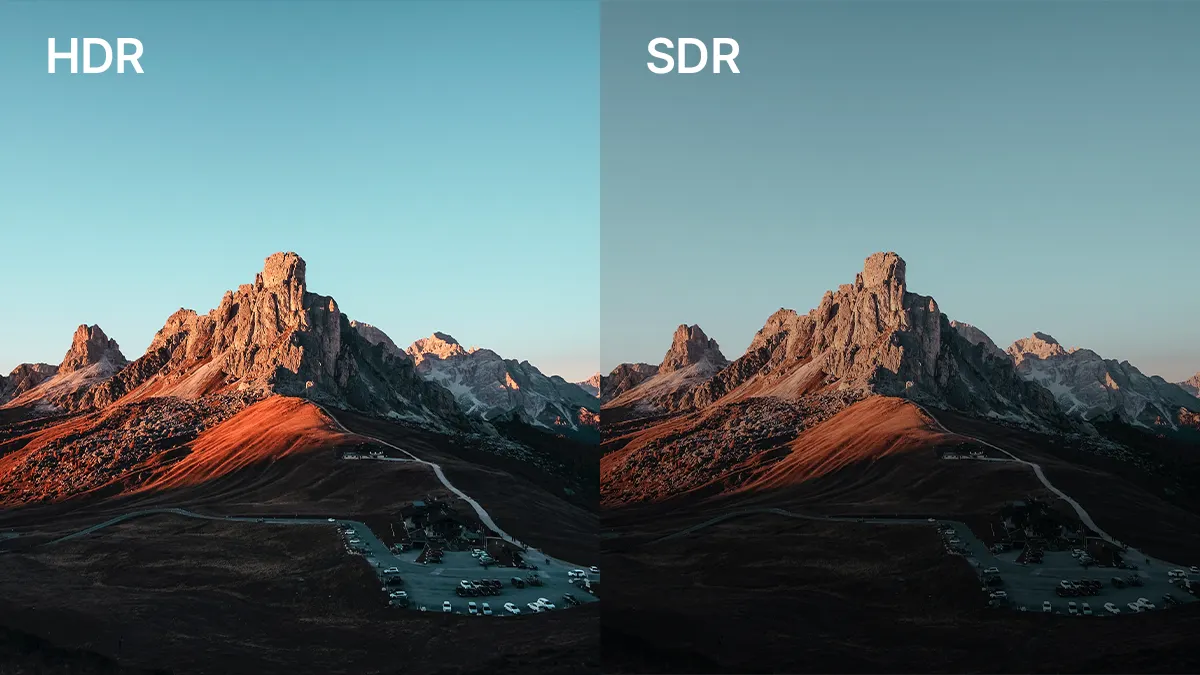
¿Qué es una pantalla HDR?
El rango dinámico alto (HDR) es la diferencia entre la luz y la oscuridad en el campo de imagen. Cuanto mayor sea el rango dinámico, mayor será la cantidad de detalles claros y oscuros que se registran en la imagen simultáneamente.
- Existe el HDR en la fotografía;
- Existe el HDR en la cinematografía;
- Hay HDR en el vídeo;
- La pantalla tiene HDR;
These uses of HDR are related, but capture, processing, delivery and display are separate stages. A camera may combine several exposures to preserve bright skies and dark foregrounds. The result can be delivered as an SDR image after tone mapping, or as an HDR image in a supported format. The camera label alone does not tell you which output you have.
Multi-frame photography can introduce artifacts when the subject moves between exposures, and aggressive processing can produce unnatural contrast. These are capture and processing issues; they do not mean every phone photograph or video is SDR. Check the recording format and the capabilities of the app and display used to view it.
For video playback, HDR involves a defined relationship between signal values and light, together with sufficient precision and a compatible display chain. PQ and HLG are two important HDR transfer systems. The player, video connection and display must interpret the signal consistently to avoid washed-out colors, clipped highlights or an unexpectedly dark picture.
Tone mapping adapts the available luminance range to the target display. It is used when converting HDR to SDR and when fitting HDR material to an HDR display whose brightness differs from the mastering display. Tone mapping is therefore not evidence that the original material was “fake HDR.”
¿Qué es una pantalla SDR?
SDR refers to Standard Dynamic Range. It is the traditional framework used for much television, film delivery and web video. SDR can be delivered at HD, 4K or other resolutions: pixel count does not define dynamic range. Compared with a well-implemented HDR system, SDR offers less room for very bright highlights while retaining dark detail. Its familiar workflow can still produce excellent images on a calibrated display.
Diferencia entre HDR y SDR
Diferencia tecnológica
The first difference is how signal values relate to light. SDR video commonly uses a conventional gamma-based display response. HDR10 uses the PQ transfer function; HLG uses a different HDR system designed for broadcast workflows. Calling all of these simply “different gamma curves” hides an important signal-compatibility distinction.
Desplácese horizontalmente para ver todas las columnas en una pantalla pequeña.
| Categoría | Resolución | Typical signal depth | Color signaling | Display implication |
|---|---|---|---|---|
| HDR10 | Independent of HDR; often 4K | 10 bits | BT.2020 container | PQ and static metadata must be interpreted correctly |
| HDR | Independent of HDR | Commonly 10-bit | Commonly BT.2020 | Requires a compatible HLG playback chain |
| SDR video | HD, 4K or other sizes | Often 8-bit or 10-bit | Commonly BT.709 for HD | Match the signal range and display response |
A format's supported luminance range is not a promise that a screen reaches that entire range. Likewise, signaling BT.2020 does not mean the physical display covers the whole BT.2020 gamut. Check source format, screen measurements and picture settings separately.
Comparación de profundidad de bits
La profundidad de bits se refiere a la cantidad de colores que se pueden mostrar por píxel. Cuanto mayor sea la profundidad de bits, más colores se podrán mostrar, lo que resulta en una gradación más suave y natural. Por ejemplo, un monitor de 8 bits puede mostrar aproximadamente 16.77 millones de colores, mientras que un monitor de 10 bits puede mostrar aproximadamente 1.07 millones de colores.
Comparación de la profundidad de la gama de colores
Color gamut describes the range of colors a system can represent or a screen can reproduce. It is different from bit depth, which describes how finely values are divided. HDR delivery commonly uses a BT.2020 container, while a screen may reproduce only part of that range. A wide-gamut screen still needs correct color management to avoid oversaturated SDR material. Compare measured gamut coverage and accuracy rather than assuming any HDR label guarantees every color.
Fotograma de vídeo
HDR video can represent a wider luminance range, but metadata behavior depends on the format. HDR10 uses static metadata; HDR10+ and Dolby Vision can use dynamic metadata to guide adaptation for changing scenes. SDR brightness also changes from frame to frame. Increasing an SDR screen’s saturation or contrast cannot recover highlight information that the source never contained.
Vídeo Luz y oscuridad
In a properly produced HDR scene, a bright sky can retain texture while a shaded foreground remains readable. The result depends on the master, tone mapping, screen brightness and room light. A small bright highlight and a bright full-screen image are different loads for a display, so peak brightness alone is not enough to judge the whole scene.
An ordinary SDR illustration on a webpage can explain this contrast but cannot prove how an HDR screen will look. Compare matching HDR and SDR material on a compatible, calibrated playback system. Pay attention to clipped clouds, crushed shadow detail and abrupt changes as the image moves between dark and bright scenes.
Detalles del vídeo
HDR does not add spatial pixels or automatically sharpen an image. Its potential advantage is preserving distinctions across a wider range of light and color. Bit depth helps encode those transitions: 10-bit provides 1,024 code values per channel compared with 256 for 8-bit. Those are signal counts, not equally spaced visible brightness steps or a guarantee that every level will be distinguishable.
HDR technology standards:
Desplácese horizontalmente para ver todas las columnas en una pantalla pequeña.
| Formato | Sistema de transferencia | Enfoque de metadatos | Que comprobar |
|---|---|---|---|
| HDR10 | PQ | Estático | 10-bit signal, color interpretation and tone mapping |
| HDR10 + | PQ | Dynamic | Support through the source and display chain |
| Dolby Vision | PQ-based delivery profiles | Dynamic | Supported delivery profile and compatible playback |
| GAN | GAN | Does not require HDR10-style static mastering metadata | HLG interpretation and the intended viewing environment |
These are delivery approaches, not fixed screen brightness classes. Supported bit depth, profile and transport depend on the implementation. None of the names alone establishes the actual black level, color accuracy or sustained brightness of a display.
HDR and SDR: Which is better?
HDR can show more convincing highlights and a wider tonal range when the source and display are capable of doing so. SDR remains useful when the target equipment, production workflow or viewing conditions favor a predictable, well-controlled image. Neither label guarantees a good master or a good display.
The quality of HDR releases varies. Heavy clipping, poorly chosen tone mapping or incorrect playback settings can make a nominally HDR image less attractive than a carefully graded SDR version. Compare the same scene, and first confirm that the player is actually sending the intended format rather than forcing a conversion.
For your own equipment, use the version that is reproduced correctly. For a venue or video wall, test presentation slides, cameras, brand colors and video together. A consistent SDR show can be more appropriate than mixing formats that the system cannot switch or map reliably. If HDR is a project requirement, define its acceptance checks before ordering the display.
¿Cómo lograr una pantalla HDR?
Evaluate the playback chain in five dimensions. Resolution and frame rate affect the viewing experience, but neither one alone makes a display HDR.
Velocidad de cuadros
The source frame rate controls how frequently new pictures arrive. LED refresh describes how the display drives its pixels and is a different specification. A high LED refresh figure does not convert low-frame-rate video into smoother source motion. Check the input frame rate, processor output, synchronization and camera exposure where the wall will appear on camera.
Escala de grises
HDR10 uses 10-bit source values. Internal LED processing may use greater precision to support calibration and brightness control, but that is not the same as accepting a higher-bit-depth source. Test a smooth ramp at the actual operating brightness. Look for banding, tint changes and lost shadow steps, especially after the wall has been dimmed for an indoor room.
Luminance dynamic range
Evaluate both highlights and black level in the intended environment. Room light reflects from the screen and can reduce perceived contrast. A bright display therefore does not automatically deliver a convincing HDR result. Request measurements or a demonstration for the proposed configuration, including sustained output and the behavior of small bright details on a dark background.
Resolución 4K
HDR and 4K are independent. An LED wall's native resolution comes from its module layout and pixel pitch. Decide whether the source will map one-to-one, scale or occupy part of the canvas. A modular wall can have a custom aspect ratio, so the project must reconcile the content resolution with the available cabinet grid rather than assume every wall is 3840 × 2160.
Gama de colores
Match the player's color signaling to the processor and display settings. BT.2020 is a delivery container, while the display has its own measured color gamut. Calibration and gamut mapping determine how the content fits that capability. Include neutral grays, skin tones and saturated brand colors in an acceptance test, with SDR material checked separately if the installation will use both formats.
¿Qué es HDR 10?
HDR10 is a widely used HDR delivery format using 10-bit video, the PQ transfer function defined in SMPTE ST 2084, and BT.2020 color signaling. SMPTE ST 2086 describes mastering-display metadata; it is not the PQ luminance curve. These identifiers refer to different parts of the signal description.
Static light-level metadata can include MaxCLL, the maximum content light level, and MaxFALL, the maximum frame-average light level. MaxCLL is not fixed at 1,000 nits for every HDR10 program. The values describe the content, while the receiving display must reproduce or tone-map it within its own capabilities. See Dolby's technical explanation of these metadata fields.
¿Qué es mejor, HDR10 o HDR400?
HDR10 and DisplayHDR 400 describe different things. HDR10 is a content format; VESA DisplayHDR 400 is a display-performance certification tier. A monitor can support HDR10 and also be certified at DisplayHDR 400. Neither label should replace inspection of the screen under your actual viewing conditions.
VESA evaluates more than peak brightness, and requirements change with the certification test specification. For example, CTS 1.2 lists 10-bit signal support and tighter gamut requirements for DisplayHDR 400 than older summaries. Check the exact certified model and applicable specification rather than relying on a generic “HDR400” sticker.
Global dimming adjusts the backlight together. Local dimming divides it into independently controlled regions, which can improve the separation between bright and dark areas. Region size and the dimming algorithm still matter: inspect halos around subtitles or other small bright objects. Self-emitting displays have different black-level behavior and are covered by the separate DisplayHDR True Black tiers.
Desplácese horizontalmente para ver todas las columnas en una pantalla pequeña.
| DisplayHDR tier | Peak luminance figure in the tier name | Interpretación |
|---|---|---|
| 400 | 400 cd / m² | Entry tier in the DisplayHDR family |
| 500 | 500 cd / m² | Check the full test criteria, not brightness alone |
| 600 | 600 cd / m² | Compare contrast, color and actual content |
| 1000 | 1,000 cd / m² | Peak output is different from sustained output |
| 1400 | 1,400 cd / m² | Confirm the certified model and test version |
Utilice el official VESA performance criteria for current requirements. A DisplayHDR True Black 400 badge is not interchangeable with DisplayHDR 400.
HDMI and HDR compatibility
HDR playback requires agreement across the source, connection and display. The source reads the receiving equipment's advertised capabilities and selects an output format; intervening switches and processors can affect that negotiation. Check the complete signal path with the intended resolution, frame rate and bit depth. An HDMI version label on one device is insufficient evidence that the whole installed system will carry the desired format.
Specify HDR as an end-to-end LED requirement
For an LED project, record the source format, frame rate, processor model, proposed display configuration and target operating brightness together. Confirm which HDR formats the complete chain accepts and how mixed SDR content will be handled. Test changes between presentation slides, camera feeds and HDR video before an event or installation is accepted.
A useful demonstration includes small highlights, dark gradients and saturated colors at the venue’s intended brightness. Keep a reference SDR version where available so that format interpretation can be checked separately from artistic grading.
For an indoor project, compare pantallas LED de paso fino and share the source requirements, screen dimensions and room conditions. Review grayscale versus brightness when defining acceptance criteria.
Pasaremos al siguiente paso a definir las dimensiones de la pantalla, las distancias de visualización, el contenido y las condiciones de instalación.
What is the difference between HDR and SDR?
What is the difference between HDR10 and HDR400?
Does HDMI 2.0a support HDR transmission?
Does HDR require 4K resolution?
Is HDR always better than SDR?
What should an HDR LED project specification include?
Analice sus requisitos de brillo.
Cuéntenos qué funciones necesita la pantalla. Podemos sugerirle una configuración cuadrada y confirmar los detalles de brillo y potencia para su presupuesto.
Solicitar cotización